Sunday, March 14, 2021

Gearrscéal: Ann agus Troscán: Rialacha an Tí


 Ann agus Troscán: Rialacha an Tí

 by JMCressy


Taobh amuigh, labhraíonn na crainn  idir a gcéile faoi báisteach milis agus grian te.  Istigh an teach, ní raibh sé chomh síochánta.

"Ná bia ag roinnt."

"Ceart go leor. “

“Nó éadaí.”

“Cinnte, is dóigh.”

“Ná bí ag cúlchaint le aon duine fúm.”

“Ná bí ag caint faoin bhfear dathúil nua fiú?”

Thost Troscán.  “Ceapann tú gur fear dathúil mé?”

“Ar ndóigh!” a dúirt Ann. “Sióg nó elf atá ionat.   Nach bhfuil do mhuintir go léir álainn?”

“Níl gach duine de na Daoine Maith álainn le daoine.”

“Bhuel, is dóigh libh go bhfuil gach duine gránna.”

D’fhéach Troscán uirthi go dáiríre.  “Titimid i ngrá le anamacha, ná dathúlacht.”

Baineadh siar as Ann.   “Anois, do shúile...”

“...ómra te agat,”  chuir Troscán bailchríoch ar a habairt.

D'fhéach siad ar a chéile fan tamall.

Chroith Ann í féin.  “Mar sin, rialacha tí !”

“Go díreach! Teastaíonn siad seo uainn. Níl mé ag iarraidh bogadh.”

“Bog? Níl tú ceangailte leis an áit seo?”

“ ‘Mar gheall ar gheasa ársa’ ?”  Gáire Troscán.  “Níl, is maith liom an áit seo.   Ach má tá na Rialacha briste, ní bheidh aon rogha agam ...”

Ansin, chuala siad cnag ar an doras.

Bhí cuma bhuartha ar Troscán, ach a dúirt Ann, “ Ná bí buartha.  Níl ann ach Auntie.”

D’oscail sí an doras.  Sheas seanbhean ar an bpóirse. Bhí gruaig ghearr, daite uirthi  agus  bhí  súile donn aici, cosúil le Ann.  Chaith sí léine gheal le bláthanna trópaiceacha agus bhí go leor fuinnimh aici.

“Oh haigh, Auntie!” a dúirt Ann. “Tar isteach!”

“Go raibh maith agat, a stór.   Thángamar as.. Sin iad!”  Bhí an cána agus an umar ocsaigine in aici leis an doras.  “D’imigh muid ar a leithéid de dheifir. Tá sé dochreidte, nach é? Mothaím...”

“ ...‘Fiche bliain níos óige.’  Dúirt tú arís, " a dúirt Ann.

“Ar a laghad!  Bhuel!  Seo cé a bhí tú i bhfolach!”

D'amharc Ann uirthi le huafás.  Bhí a haintín ag féachaint go díreach ar Troscán.

Sheas Troscán ag an scanradh freisin.  “An bhfeiceann tú mé?”

“Is féidir le gach cailín tú a fheiceáil!” a dúirt Auntie. “Tá sé dathúil, nach é?”

Chas Troscán a cheann agus d'fhéach sé ar Ann. “Is féidir léi mé a fheiceáil.”

“Na habair!” dúirt Ann de chogar.

Shín Auntie amach a lámh chun Troscán.   “Is mise Aunt Gabby.  Glaoigh orm ‘Auntie’.”

“Croith a lámh,” dúirt Ann.  “Bhí  normálta.”

“Haigh. Is mise Troscán.  Tá mé i mo chónaí san áiléar.”


“I ndáiríre? Tá lochta ag mo mhac sa Ghearmáin.  An bhfuil tú i do chónaí in aice láimhe?”


“Tá. An-ghar.”

“Agus tá an feisteas sin go hiontach! An bhfuil sibh ag dul chuig cóisir?”

Bhí Ann buíoch as an leithscéal.  “Sea! Níos déanaí,” a dúirt sí.

“Um tráthnóna,” dúirt Troscán.

“Anocht,” a dúirt Ann.

“Sin réalaíoch.  Tá an chuma air go bhfuil adharca ort i ndáiríre!”

“Cén fáth go bhfeiceann sí mé?”

“Níl a fhios agam...”

“Bhuel, táimid dul go dtí an Spáinn! Feicfimid sibh i gceann coicíse!” a dúirt Auntie. “Tá spraoi againn! Go deas bualadh leat! Slán!"

Thóg sí na rudaí agus d’imigh sí.

Bhí siad báite ina gcuid smaointe ar feadh tamall.

“An raibh an bainne atá ann?” a dúirt Ann

B'fhéidir.   Ach, nach bhfuil sé sin thart?

“Fan! Ar ól tú mo bhainne?

Ar ndóigh. D’ól tú mo cheannsa. Ní dochar ar bith é sin.   Gan an draíocht, an tsubstaint...”  chuaigh a ghlór in éag.

“Déantar tú básmhar?

“Ná bí amaideach. Díreach le feiceáil.  Bhí an tsubstaint a bhí fágtha dhá uair chomh trom.”

Dhún sé a shúile nóiméad.

“Damnú air!” a dúirt sé.

“Ceard?” a dúirt Ann.

"Ní féidir liom mé féin a chasadh dofheicthe."

“An bhfuil sé sin go dona?”

“Tá.  Ní fheictear dúinn riamh ach amháin iad siúd atá in ann a fheiceáil. Agus iad siúd a roghnaigh Féach.

“An bhfuil sé buan?”

“Níl a fhios agam.   Ach mura bhfuil, tá trioblóid ag teacht.”

Anois bhí na crainn go ciúin. Ach níl an ghaoth suaimhneach.  D’fhéach Ann ar an spéir amuigh.  Rith scamaill dhorcha stoirmeacha roimh ghaoth, agus é ag brostú chun a rúin a insint.

Cibé rud a bhí ag teacht, bheadh a fhios acu go luath.


~~~

Nótaí údar: 

Bheith sé sin deireadh gearrscéalta ar feadh tamall.  Rinne mé iad a cleachtach mo chuid Gaeilge.   Ach anois, tá obair ar mo scéalta eile(faraor, as Béarla) uaim.  Agus rudaí ealaín mar sin.  Beidh mé ar ais le Troscán agus Ann, lá amháin.  

Go raibh maith agaibh.

JMC

~~~

Scéalta le Ann agus Troscán

1: Naoi Bhfocal, Ón Taobh  (Ar dtús i mBéarla)

2: Bainne na nÓg

3: Rialacha an Tí


Friday, March 5, 2021

Gearrscéal: Ann agus Troscán: Bainne na nÓg


Ann agus Troscán: Bainne na nÓg

by JMCressy


Seachtain an-aisteach a bhí ann le Ann. 

Ar dtús, ag a háit oibre, chuir siad córas ríomhaireachta nua.  Ansin rinne sí dearmad go raibh a uncail agus a aintín ag teacht ar cuairt inniu. Agus, bhí a lán rudaí draíochta a chonaic sí anois: sióga sa ghrian, sióga ar bhláthanna, ar na crainn, agus ceann san áiléar nach raibh ar eolas aici faoi. Troscán an t-ainm a bhí air, agus, seachas a adharca, bhí sé ina fhear óg dathúil. Cé a fhios cá fhad a bhí cónaí air sa teach céanna. Ach, cosúil leis nó nach raibh, bhí comrádaí tí aici.

Ba é Dé Sathairn inniu, an lá a raibh aintín agus uncail Ann ar cuairt.  Bhí siad an-sean agus ní raibh sláinte mhaith acu. Bhí droch-chromáin ag a haintín agus d’úsáid sí cána. Bhí emphysema ag a uncail agus bhí ocsaigin ag teastáil uaidh i ngach áit a ndeachaigh sé. Bhí súil aici nach dtarlódh aon rud aisteach agus iad ag a teach. Bhí sé ró-dhéanach a gcuairt a chur ar ceal. Mar sin, nuair a chonaic sí Troscán—sin corr-ainm! – go bhfuil ag oscailt an chuisneora agus ag ól díreach ón gcartán bainne, chaill sí a meon.

“Cad atá á dhéanamh agat?” a scairt Ann, ag rith sa chistin. Bhreathnaigh sí sa chuisneoir. Shuigh an bainne gan oscailt. Ach bhí an cartán bainne céanna i lámh Troscán.

"Cad?" a dúirt sí, mearbhall uirthi.

“Tá daoine chomh neirbhíseach ,” a dúirt Troscán. “Is liomsa é seo. Is leatsa é sin. "

"Ach níl ach cartán amháin ann."

"Tá."

Níor theastaigh míniúchán ó Ann. Draíocht na sióg a bheadh ann agus ní thuigfeadh sí tada.

"Go breá!" dúirt sí, ag breith ar an gcartán eile agus á cuir ar an mbord. “Teastaíonn seo uainn don tae.”

"Ó, sea tá do mhuintir ar cuairt!"

“Sea, agus mura miste leat, b’fhearr liom go mbeifeá áit éigin eile ar feadh tamaill.”

“Ná bí buartha,” a dúirt Troscán. "Ní fheiceann siad mé."

Sula bhféadfadh Ann sonraí a fháil, leag sé a cartán síos ar an mbord agus d’imigh sé gan tásc ná tuairisc. Bhí a fhios aici nach raibh sé imithe. De réir cosúlachta an t-áiléar a raibh cónaí air--ní raibh sé sin ann i saol an duine--ní raibh ach “twinkle away” nó caca éigin.

Is cuma léi. Rinne sí an tae, agus leathuair ina dhiaidh sin tháinig Auntie agus Uncail George.

Bhí siad ag caint sa seomra suí- bhí Auntie ag smaoineamh ar obráid athchur cromáin - nuair a chuaigh Troscán isteach, i t-léine agus i mbríste aclaíochta, ag triomú a adharca le tuáille. Chaith sé é féin i cathaoir uillinne, cos thar lámh amháin, ansin thosaigh sé ag scrollaigh trína fhón póca. Cathain a d’úsáid na sióga teileafóin phóca?

“Anois, cad fútsa?” bhí Auntie ag fiafraí. "Ar bhuail tú le fear óg deas fós?"

Rinne Troscán gáire os ard faoi seo, chomh hard sin bhí Ann cinnte go gcloisfeadh Auntie agus Uncail George. Ach níor thug siad aon chomhartha gur chuala siad nó go bhfaca siad an fear sí.

Ghabh Troscán a leithscéal. “Brón orm, ní raibh neart agam orm féin,” a dúirt sé. “Gheobhaidh mé roinnt brioscaí ...” Shiúil sé go dtí an chistin.

Rinne Ann iarracht neamhaird a dhéanamh air. "Cad mar gheall ar níos mó bainne?" a dúirt sí, doirt cuid den chartán ina dhá chupán agus agus í féin.

"An-deas. Ach ní freagra é sin ... ”

“Gabh mo leithscéal,” chuir Uncail George isteach, “Cén cineál bainne é sin? Coinníonn an cartán ag athrú datha ... ”

Ar eagla na heagla, rug Ann ar an gcartán. Branda hipster a bhí ann, le bó chartúin ag gealladh úire. Ach, bhí an bhó a bheith ag spraoi go mall sa ghort, an pictiúr ag bogadh cosúil le nuachtán i Harry Potter, agus bhí grian an chartán ag luí, ag athrú dathanna an chartán dá réir.

"Troscán!" a scairt Ann. Ansin chuimhnigh sí nach bhféadfadh aon duine eile é a fheiceáil. Bhreathnaigh a haintín agus a uncail timpeall, ag an troscáin, ag smaoineamh ar cad a bhí mícheart.

"Tá brón orm!" a dúirt Ann, ag smaoineamh go tapa. “Ba ardú céime speisialta é. Pacáistiú beoite. Ach tá sé an-daor! Cuirfidh mé ar ais sa chistin é ... "

“Tá sé ceart go leor,” a dúirt Auntie, ag seasamh suas. “Caithfimid dul ar aon nós, nó beimid déanach inár gclub beiriste.” Phóg Auntie Ann ar an leiceann. “Ach caithfidh tú insint dom faoin bhfear nua seo i do shaol…. Goitse, George.”

Faoisimh uirthi, bhreathnaigh Ann ar George ag éirí aníos agus leanann a bhean amach an doras. Go gairid thiomáin an carr ar shiúl.

Ansin bhreathnaigh Ann ar an gcartán bainne. Bhí an bhó ar an bhféar ina codladh agus réaltaí ag maisiú barr an chartáin. Ghlaoigh Troscán ón gcistin, “Cá bhfuil mo bhainne?”

“Sílim gur ól muid é ...” a dúirt Ann go neamhchinnte. Ní raibh a tae ólta aici. Ghluais an leacht timpeall amhail is dá mba ag corraigh féin. Bainne sí. In ainm Dé…

Go tobann bhí Troscán ag teannadh léi. D’athraigh fearg a chuma. Bhí sé go hálainn fós, ach lonraigh solas contúirteach óna shúile agus chaith sé scáth thar an seomra.

"Ar ól tú mo bhainne?" a scairt sé, a ghuth ag macalla cosúil le céad adharc.


Ach ní raibh eagla ar Ann.

"Ná béicíl orm i mo theach, ‘Galadriel Dorcha’!"

Ansin mhaolaigh an scáth taobh thiar de Troscán.

“Tá an-bhrón orm,” a dúirt sé. “Ach ní rud cliste é sin le déanamh. Tá rialacha ann ... ”

“Níor theastaigh uaim é a dhéanamh! Caithfidh gur rug mé ar an gceann mícheart... ”

Ansin chonaic Ann dhá rud, rudaí a rinne Auntie agus Uncail George dearmad:  cána agus umar ocsaigine.

Lig Troscán osna throm as. “Tá súil againn nach bhfaighidh mo mhuintir amach.”


~~~

Scéalta le Ann agus Troscán

1: Naoi Bhfocal, Ón Taobh  (Ar dtús i mBéarla)

2: Bainne na nÓg

3: Rialacha an Tí


Making Acorn Flour

 ~Tá dearcain an-úsáideach


Red Oak in glade

WARNING: In an effort to not kill my readers, I should emphasize ACORNS ARE A NUT.   If you have tree nut allergies, do not experiment with acorns before consulting with your health care professional.


Acorns can be used for many things:   fodder, ink and dye, and you can eat them.

Acorns are one of the oldest pre-agricultural human foods.  They are abundant, easy to gather (if you don't mind being cursed out by squirrels) and once oaks are established, they produce for longer that a human lives.  And Acorns are free for the taking!

But today there are only two human cultures who use acorns with even semi-regularity: American First Nations and Koreans.  By the time of recorded history in Europe, acorns were considered famine food, what people ate when they were desperate.  One wonders how good starving Europeans could have been at processing; it's unlikely the skills to make acorns palatable survived with such infrequent use.   Despite the  abundance of acorns and, currently, free cost, there are some drawbacks for commercial use:

- An oak tree takes about 20-40  years before producing acorns.   If you're an long lived species, like elves, no problem.    But since this the average time humans take to mature to adulthood, it's not ideal for starting a staple crop.

- Oaks do not produce reliably every year.  Many trees alternate mast years, that is, one year they dump acorns so thickly you're still walking on them in the winter, and the next, there's hardly any.    Though in my personal experience it's not that extreme: just a lot less acorns in the off year, but still enough. While one tree is under producing, another, across the stream is dropping acorns like bombs.  So mast years appear to be dependent on water, weather and other environmental factors.

- Acorns require leaching to remove tannins which, in large quantities, are toxic to humans. And believe me, acorns have a lot of tannins. Bite into one and it will dry your mouth out and you won't be able to swallow it. Traditionally leaching was done in baskets in streams, or buried in soil.  Some Peoples ground and then leached them, pouring water through the meal.  Grinding first and leaching can be faster, as can using hot water.  But nutrients are lost, and, in the case of hot water, leaching it can go horribly wrong and fix the tannins in the acorns permanently, making them inedible.  

- Oak trees were valued more for building and firewood by colonial cultures, reducing the amount of oaks producing acorns for peoples still eating them. I could see how this turned into a downward spiral and people turned to quicker growing crops.  


I've been gathering and processing acorns for almost 4 years, after first researching the material of people rediscovering this staple. For those who want to try their hand at making and using acorns for food, this is how I do it:


1. Gather acorns.  That's obvious, but you need to identify oaks.  If there are no oaks on your property, best bets are public parks or right of way.  Legally you can gather from pavements besides people's houses and property, but please ask for permission before going onto private property.  Be polite and respectful.


Identifying oaks: The two main types of oaks are white and red.   White oaks have the round lobbed leaves.  Red oaks are pointed.  There are many more sub species and oaks hybridized so easily even experts can have trouble telling them apart.  But, as far as I know, all acorns are edible.

Much is made of White Oaks, which are the Holy Grail of foragers. Allegedly their acorns need no leaching.  But the best I've found are some that I could eat raw, if I had to, but were far from pleasant.  Research that suggests humans vary in their ability to taste tannins in acorns.  Unfortunately, this does not mean these acorns are less toxic to the individuals.  According to this document, ALL ACORNS MUST BE LEACHED.  In addition to removing tannins, which not only taste bad but interfere with nutrition, acorns need their phytic acid removed or neutralized(more in notes at bottom of page). 

2020 Harvest
 

I'm so glad I always leach any acorns I gather.    


2. Shelling/Hulling:


Once I gather the acorns, I shell them.  Some people use a rock or hammer.  Resourceful folks have made special mills to hull in mass.  Good on them!   I use a nutcracker and a bowl, usually while I'm watching a program.  


3. Leaching:

All acorns need to be leached.  Once I  shell the acorns, I put them into a sturdy plastic container, fill it with water and close the lid.  If the container is to be outside, a lid is ideal because squirrels WILL steal them.  Sometimes when I have too many, I put them in buckets and fill them with a lot of water which is a deterrent.  But as they acorns leach, that is get sweeter, the squirrels get bolder.  One has to watch them carefully.

Every day I pour the water off, and fill it again.  It's not the most efficient leaching method, but without a stream or river, it gets the job done.  The leaching process on average takes anywhere from a couple weeks to a month.I will know it's finished when the acorns are completely saturated AND when I break one apart and nibble on it it isn't dry and bitter.  Personally I like a little nutty bite to the flavor. And I worry if I leach them bland, I'm losing nutrients.  But they should not dry the mouth out.


4. Drying:

I dry before grinding because I find the acorns develop a lovely nutty smell that way.  But either will work.    For ease of grinding, I only half dry them.  Ideally this takes a week.  If it's taking longer, check the humidity and watch for mold.


5. Grinding:

 Once they're half dry--dry on the outside, firm, but still have moister if squeezed-- I roughly chop them in about 1/4 inch pieces, then lay them out on a mesh to dry some more. A couple days to a week later they should be ready to be ground down to meal.

Note:  I dry in stages for two reasons: to preserve flavor and to avoid grinding a rock hard acorn nut which takes...for...ever.


6. Final grinding:  The dry meal should be ground as fine as the appliance can get on the first pass.

Once a batch is all ground, I sift it and grind it again, as fine as possible.  


Now the flour is finished.  It is best stored in the refrigerator in an airtight container.  


Yield: A paper grocery bag filled with acorns usually yields about 8 cups of flour after about a month of work.  


Flour properties: 

The best flour I've made is a light buff or tan color and has a rich nutty flavor.  Darker flour means its lower in fat or has dried out a bit more than ideal at some point in processing, but is still usable.  Some insist white or nearly white flour is possible...and fair play to them!   Keep chasing those unicorns!

I use acorn flour like corn meal, 1-to-1 replacement in cornbread.   

Acorn flour has no  gluten, so it must be mixed with other flours if yeast is the leavening.  It is reasonably responsive to soda leavening, though personally I find I must use eggs for the best results.  And mixing in other flour will make a finer texture.  For pancakes, I use a ratio of 2/3 acorn flour to 1/3 of spelt or barley or oat flour.

After baking, it is much darker than one expects.  Pancakes are lighter.  Left over acorn bread can be used for stuffing or breadcrumbs. 

Final note:  I have had no problems digesting acorns.  But I have noticed a tendency for "firmness" in the bowels.  It makes me drink water regularly, like I should be doing anyway.  But this makes me think people who might have kidney trouble should do some research and go cautiously forward.   

New foods can be exciting but health comes first.


Final notes:

Making acorn flour is a lot of work.  But much of that work is passive: leaching acorns sitting in water while I do something else. And if a community was involved, at least the gathering would go much faster.  I would far prefer to tend an oak orchard than plough a field for my staples, and then cut, church, thresh, etc, etc.  Smart people looking at feeding themselves on a small scale stay away from depending on wheat and corn.  Growing grains efficiently requires community effort even on the small scale.  A family or small groups should be relying on beans, peas and other pulses, and possibly potatoes.  And maybe look to the trees...


Humans could resolve two serious issues at once by supporting more tree crops for food production: our growing food insecurity and environmental degradation.  Chestnut, Oak, Beech, and of course the standard nut trees have fed cultures for aeons.  There is the problem of nut allergies. But for those who can eat nuts it would help quite a bit to relieve the burden. And they're tasty too!

Trees support the soil, clean the air and give us food.  The trees could save us all... if we let them.


Further reading:

 BULLETIN OF PRIMITIVE TECHNOLOGY SPRING 2014: 

No. 4774Do Sweet Acorns Still Need To Be Leached?

By Arthur Haines, Delta Institute of Natural History


https://static1.squarespace.com/static/52765bc6e4b094d525e06bad/t/5810d5d0f7e0abd1f4bd4e7d/1477498321694/Arthur+Haines%2C+Do+Sweet+Acorns+Still+Need+To+Be+Leached.pdf

Excellent information and history.  Also has an alarming detail about phytic acid in other foods:


 Phytic acid is a storage form of phosphorous in seeds
(phosphorous is an important mineral for germinating
plants). Phytic acid, which is found in acorns and other
nuts, grains, legumes, and achenes, is another antinu-
trient that is capable of chelating with dietary minerals.
Therefore, phytic acid, like tannins, makes minerals
unavailable to the body (and those mineral pass through
the system without being absorbed). Additionally, phytic
acid can interfere with enzymes we need to digest our
food, such as amylase (for carbohydrates), pepsin (for 

proteins), and trypsin (also for proteins). Therefore, it is
important to limit our intake of phytic acid so that we do
not experience mineral deficiencies and inhibit digestion
of food. It is worth noting that most foods commonly eaten
in the United States today that contain phytic acid have
not been prepared in a way to minimize the levels of this
antinutrient.


That can't be good...


Sunday, February 28, 2021

Gearrscéal: Naoi Bhfocal, Ón Taobh


Naoi Bhfocal, Ón Taobh

Nine Words Sideways

(scéal i mBéarla agus i nGaeilge)


Ann lived alone. Usually she didn’t mind, but she missed her friends, most who had moved away after school. She had very little in common with her coworkers. Her job was a dull, but it paid well so she was disinclined to leave. The pay also allowed her to indulged her interests, particularly books, of which she collected many. Among books on sailing, gardening and history, she had kept books from her childhood. One in particular was her favorite, a book on fairy tales. She’d read and reread it so many times she knew it by heart.

But a part eluded Ann, an inscription in the front, printed in an old script. It read:


Say this with your eyes shut

Motuigim bolah an Eireannaig binn breugaig faoi m’foidin dutaig

And you will see what you will see.


Now and then over the years Ann would return to it, searching for clues, first at the library, then online. She learned it was in Irish. One forum dedicated to Irish language had decoded the letters into something slightly more readable. But it took Ann the better part of an afternoon of research to get an approximation of what it might mean and still she wasn’t sure. “Feeling the soul of Ireland” ? It was garbled through culture and time. As for how to say it, no one really knew.

A curiosity had taken root. Ann didn’t know why. She wasn’t Irish(that she knew of). But a desire to solve this one mystery from her childhood drove her on. She found a transliteration into modern Irish. She muttered this to herself as she read it, as best she could, and a something inside her changed.

Work was the same, but more dull. Ann thought more of taking a course and changing professions. But the words were ever in her mind. She muttered them in the morning after rising, and in bed at night. Even on the bus to and from work. With every thought, the words sank deeper into her, pressing their form on her soul, morning, noon and night.

Like the hacker tool ‘brute force’, Ann seemed to be trying every combination until one worked. There is a limited number of ways to pronounce these nine words, so it was just a matter of time before she said it right.

It happened one morning while she was brushing her teeth. The sounds she’d struggled with, were, if not perfect, intelligible to the people of the time who wrote it down. And, in that moment, she squinted enough that her eyes were, for the most part, shut.

Something inside Ann moved again. She felt the light change. She blinked.

And ansin....feiceann Ann timpeall. 

Taitníonn an ghrian tríot an fhuinneog. Bhí scamaill beacha os cionn an rósóg in airde taobh amuigh. Ach, bhí rud eile ar na rósanna: léimeann na créatúir bídeacha óir le sciatháin ó gach peiteal sa ghrian. Sióga óir a bhí iontu.

Dhún Ann a súile. B'fhéidir, bhí sí fós ina codladh, ag brionglóid. D’oscail sí a súile. Taitníonn solas na gréine isteach sa seomra folctha anois. Tháinig cúig sióga óir leis, ag damhsa ar an doirteal. Bhí siad go hálainn, ach bhí sí buartha go raibh sí as a meabhair. Chuala sí canadh freisin: “Blah, blah, blah”. Tháinig se seo as na sióga óir nuair a bhí siad ag damhsa. Tharraing Una anuas na dallóga, ag coinnigh an solas amach. D'imigh na sióga.

Chan siad taobh amuigh fós. B'fhéidir, dá ndéanfadh Ann neamhaird orthu, rachaidh siad imigh. Bheadh sí an-mhall. Chaith sí uisce ar a aghaidh. Mar a thriomaigh sí í féin, bhuail duine éigin ar an doras seomra folctha.

Stán Ann ar an doras, le huamhan. Bhí sí ina cónaí sa teach léi féin. An buirgléir a bhí ann? Cén cineál cnag buirgléir chun an seomra folctha a úsáid?

“Brón orm,” a dúirt guth, “An mbeidh tú i bhfad?”

Go tobann d’fhág an eagla í. Rug Ann ar na pionsúirín géar (ar eagla na heagla) agus tharraing sí an doras a oscailt.

Sheas fear óg tanaí ard os a comhair agus an-chrosta. Chaith sé jíons teilgthe agus t-léine a léigh, “Bua T-nOg”. Bhí súile glasa aige agus gruaig fhada dhubh air. Bhí dhá adharc gabhair ar a cheann aige freisin, agus bhí scairf a d’athraigh dath aige. Ar dtús bhí sé glas, ansin ór. Ansin bhí éisc ag snámh air, amhail is gur teilifís a bhí ann.

“Ní tusa an t-aon duine atá ina chónaí anseo, tá a fhios agat,” a dúirt an fear.

Thit na pionsúirín as a lámh.

Chrom an fear, thóg sé iad den urlár, agus thug sé ar ais do Ann. Shnámh na éisc ar a scairf go dtí na foircinn, ag beathú amhail is dá mbeidís ar bhun locha.

“Anois, mura miste leat ...” a dúirt sé, ag brú anuas uirthi agus ag dúnadh an dorais.

Níor chreid Ann é. Mura raibh a meabhair caillte aici, geas a bhí sna naoi bhfocal. “To see what you will see”. Shíl sí go tapa: an féidir léi é a aisiompú?

Rith Ann go dtí a seomra leapa. B’fhéidir go ndúirt an leabhar rud éigin níos mó. Ach bhí an leathanach leis an inscríbhinn bán.

Bhí sé mar an gcéanna lena leabhar nótaí. Bhí gach leathanach leis na naoi bhfocal bán. Chuardaigh Ann a fón. Ní raibh na focail ina stair chuardaigh. Fuair sí an fóram céanna. Ach bhí an snáithe imithe. Cibé draíocht a thoghairm, bhain sí iad ó gach cartlann, téacs nó digiteach.

“Nah, níl ach cinn a d’úsáid tú,” a dúirt an fear. Bhí sé ina sheasamh sa doras, ag triomú a adharca le tuáille. “Níl sé uait níos mó.”

“Cad é?” dúirt Ann.

“Breathnaigh!” a dúirt sé , dhírigh sé ar amach an fhuinneog. “Is breá leis na sióga gréine na bláthanna.”

“Bláthanna?” macalla Ann, ag breathnú taobh amuigh. Gan dabht, rince na créatúir sióg ar na rósanna, na lus móra agus fiú an féar.

“Nach gcloiseann tú iad? ‘Bláth, bláth, bláth’. Sióga gréine. Leanann beacha iad.”

“Ar ndóigh déanann siad,” a dúirt sí, “Ceist amháin.”

“Cinnte.”

“Cé sa diabhal atá tú agus cén fáth a bhfuil tú i mo theach?”

“Mise Troscán. Tá mé i mo chónaí san áiléar.”

“Níl áiléar agam!”

“Ní raibh tú in ann a fheiceáil roimhe. Tá sé ón taobh.”

“Ón taobh?”

“Le domhan an duine. Bhíomar anseo i gcónaí. Anois is féidir leat a fheiceáil. Nach é sin a bhí uait? ”


JMCressy©2021


Notes:


Bhí mé ag triail an scéal seo a chríochnú do “Splonk” ag deireadh mhí Feabhra. Bhí 1,700 focal aige agus teastaíonn níos lú ná 500. Tar éis sé uair, tá 1000 focal aige. Is gearrscaeal é, ach níl sé an-ghearr. Mar sin, chuir mé é ar mo bhlag. Bhí sé cleachtach maith agus is é an chéad scéal a scríobh mé le Gaeilge ann.

Má rinne mé botún… agus rinne mé go cinnte...abair libh.

This is part of a series of Modern Fairy Tales I work on in between other projects.

Inspiration for this particular tale goes to book with the real inscription, in “Celtic Fairy Tales” , collected by Joseph Jacobs and published by John Nutt in 1892. Sadly, that page in my copy isn’t blank.


 ~~~

Scéalta le Ann agus Troscán

1: Naoi Bhfocal, Ón Taobh  (Ar dtús i mBéarla)

2: Bainne na nÓg

3: Rialacha an Tí


Tuesday, December 29, 2020

Nollaig Shona Daoibh!

Tá mé an-mhall an bliain seo....


pioc cárta ... aon chárta


Christmas cards finally sent...better late than never!


Monday, October 12, 2020

Book of Kells: Finished, Submitted

 At long last, it's done.

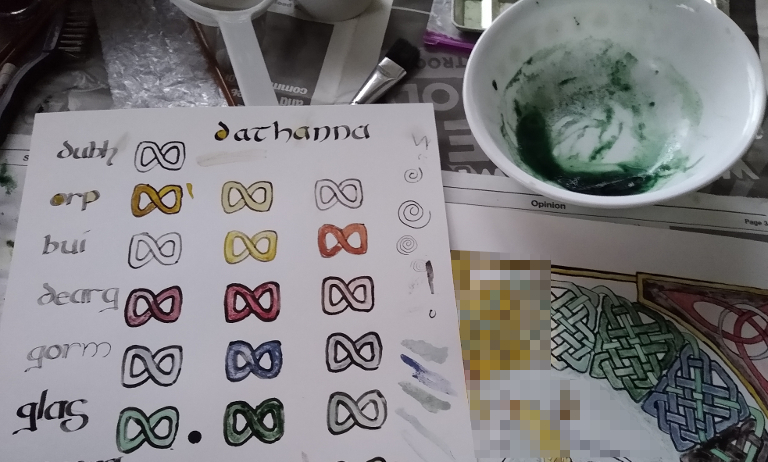
But I cannot publish the finished art because of the rules of the contest. I can publish the  low resolution color test sheet, with all its mistakes and scribbles:


What I learned: those monks are metal. Even limiting myself to natural materials and the morning light, I still had the advantage of central heating and food security.  And modern conveniences.  If poor Brother Cadfael  wanted a hot cup of coffee, he had to wait for the Renaissance.  Tea wasn't much better.  Whatever hot drink...herbal tea, beer, wine...it would have been a hassle to heat it up.  There was no microwave in the scriptorum!  

While I succeeded in creating colors from all natural sources ( to which some pedant will say: "Actually, petroleum is a natural source".  Dun do bheal!), I completely failed at even coming close to a majority of the original pigments.  Historical pigments used:

Gall Ink

Indigo 

And that's it.

Now if I was to expand that to pigments documented to be used in the Middle Ages, we can add:

Iris Green

Zinc

Any lake puts us in the Renaissance.  Sticking to known medieval practices, the best I could say is 4.  But all natural sourced... that is, what a monk or medieval artist could make with the materials and technology of the time.

Here's the color sheet with source pigments labeled:


As for the contest, feicfimid.

.


Thursday, October 8, 2020

Book of Kells Project: Border, Washes and Finishing Touches

After all the main elements were finished, some details required creatively mixing color.   

Orange/Oráiste

This color is conceptually a modern invention.  It isn't that the ancient Irish didn't see orange.  Linguistically they just considered it a type of dark yellow. There's some very interesting documentation about how different languages develop words for colors depending on their lifestyles, the cultural importance of the color and it frequency or rarity.

Even in English the word for "orange" is the same as the non-native fruit, implying in the original Anglo-Saxon we also thought of "orange" as a kind of yellow or gold.  The point being I needed ORANGE for a design element. And so I did it the typical way and mixed  red and yellow, or rather, some madder lake and tansy lake.  


It was a reasonable result, pretty if not authentic.

Around this time I also mixed up the mullien lake, made without chalk.  I wanted a  less opaque yellow for some details.


Pink/Bándearg:

I actually had some pink madder lake I could have ground up.  But the zinc and madder lake were still available and I was tired out with grinding.  So I made a mix with a little water to wash and detail a background.

Grape Hyacinth and Bluebells inks:

I did not freeze these like I did with the Iris Green. That was a mistake.  I did add alcohol, thinking that would be enough to preserve them.  While they did not mold, or otherwise physically degrade, their colors suffered.  The grape hyacinth was no longer purple or even lavender, but a weak yellowish green. Ditto for the Bluebell Ink, that also lost it's magical two tone quality.

Nonetheless, these are colors useful to tint backgrounds. See, as the art was finishing, I was noticing how very BRIGHT the background was compared to the art in the Book of Kells.  This is down to using vellum and the age of the vellum.  Considering the quality of the lighting at the time, the monks would probably have preferred a bright white background if they could get it.  But stylistically, it was too much so I was looking for something to dim it, just slightly.  These inks served well.

There was also mixing and blending for small details, like madder lake and zinc to make a silvery white for the moon.

"Crottle:

This lichen ink was also a useful background wash, mainly for the snakes.  Of all the washes it came the closest to imitating old vellum.  Maybe I should have used it from the beginning.

Book of Kells Project: Donn with Chestnut

 It's a very bad pun.   

"Donn" is Irish for brown and sounds like "down" in some dialects.

Yep.  Ní duine greannmhar mé.  Moving along...

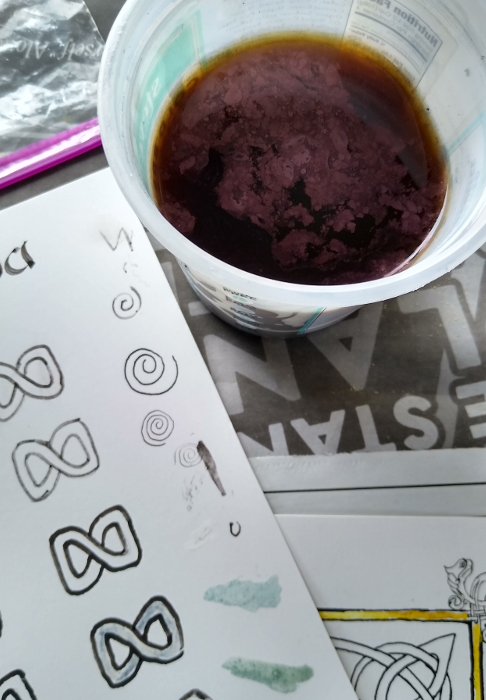
Chestnuts are a staple I forage for in the fall.  I use them in stews, cakes and stuffing.  When boiling them during processing, the liquid was always dark brown.  Surely this could be used for ink or something, right?

Well, yes. Any nut with tannin can be processed with iron salts to produce ink.  Chestnut is less dramatic than oak galls or acorns, but it does work.  The color isn't black, but a warm dark brown.  Which is useful when you need brown.


Chestnut ink was a nice accent.  It also served as a substitution for the lack of any purple from the orchil disaster.  Really would have liked that...

As an aside, dark brown in the manuscript is attributed to iron gall ink.  But I wonder if this just isn't age or a reaction with the vellum substrate?   Because my oak tannin based ink is BLACK.  But I could imagine it might shift tone with age.  

Wednesday, October 7, 2020

Book of Kells Project: Applying Green, Red and Blue

  Glas:


 Months ago I made iris green and, because unlike verdigris, it would go bad, I froze it to use later.  Now it was time to bring it out and let it thaw.

This turned out to be quicker than I thought.  I was worried it might be too thin, but as it thawed, I realized the freezing had done may work for me.  While some water remained frozen, I could pour off the green liquid that had a lovely concentration.  

And it was green now, not dark teal, and certainly not purple.  I had thought I might have to add a couple drops of water with soda ash to shift the color.  But I didn't.  It was green right out of the jar.  And it flowed great.  Not as smooth as the "gall" ink, but pleasant enough.   I applied it with a brush and it went rather quickly.

Iris lake was also used for a darker, forest green.   It would need to be mixed carefully like the other lake pigments.  


In retrospect, I regret not making verdigris.  My concerns about corrosion would have likely been mitigated by the thick paper being used.   Certainly in the short term it would have been safe.  Perhaps next time.

Dearg:


This was the moment madder was made for.  Having figured out how best to mix a smooth pigment, I almost ruined it by rushing the process.  The first madder I applied, the first lake of deep crimson, was grainy.  I just stopped, let the mix sit and did something else for a while.  When I came back, it was perfect. Then I ground and mixed the second lake of red and applied it. Things were coming along.


Gorm:

It couldn't last.   Woad blue was turning out to be my personal nemesis. Try as I might, I could not bring the bright blue of the dye or the deep royal blue of the extracted indigo into a pigment of equal vibrancy on paper.  After some reading, I heard about using indigo flower, the simmering "bloom" on the top of the indigo vat. As it happened, I was making small vats for another art project, so I just brought one in and used a brush to lift the bloom. 


It's not an efficient process.  I started to suspect that if I had mixed freshly extracted, still liquid indigo I would have had better results.  It did make a bluish wash, a tint really, and was better than the earlier blue gray disaster.   But it wasn't blue.   Then I remembered the columbine lake. 


This is what I used for the main patch of blue, painting over the indigo flower.  I left a border untouched so one could compare the effect.  

 In another belated reversal of opinion, I think I should have left the indigo flower.  It was subtle but more natural.  I suppose if the columbine lake completely fades, the indigo will come back into it's own.


Book of Kells Project: Grinding and applying pigment 1

 Earlier in the year, when I'd first extracted indigo pigment and made the first lakes, I was so excited.  All I had to do was grind them, mix them with gum and water, and I would have homemade paints.  Yay! Bhí an-sceitimíní orm...

About that...

The experiment with indigo was less than satisfying but instructive.  

Firstly, indigo doesn't grind down and mix into the lovely blue that one expects from dying.  At best, it makes a navy blue grey.

Secondly, it was grainy.  I thought I wasn't able to grind it finely enough, even though I bought a chemist mortar and pestal for this purpose. That was part of the problem.  But I was to find out the method that worked for me was to grind it as fine as possible, WITH gum arabic, then mix a little water and alcohol, grind it some more, then let it sit for 15 minutes to a half an hour.  THEN grind mix it once more to ensure consistency, adding a little water if needed.

This is not the method used for traditional oil paints.  The pigments used in the Book of Kells are all in the category of water colors: a finely ground pigment, with a binder and water. It's simple, but requires some practice.


Taking the lead from unfinished pages in the manuscript, after inking, I applied the false orpiment.  Both the laked tansy and laked mullein produced workable paint with minimum of fuss.   After testing them both, I decided tansy made a better orpiment substitute.  Regretfully, I was never able to grow enough weld in time to experiment with laking it.  Perhaps next year.

Next, I made some washes with the pale blue lakes, woad and columbine, as a back ground to the center piece.  These were much less satisfying, being grainy and uneven.  This was where I started to let them "soak" a bit.  Fortunately they are pale and give a rough textured effect which, while unwanted, is artistic in it's way. 

The zinc white was extremely easily to work with.  It also doubled as a sort of "white out" if used in very small doses, to cover minor smudges.   It neither has the coverage of real whiteout, nor do any of the pigments have 100% coverage, so one really must plan to be as careful  as  a monk in a scriptorium with nothing else to do.

With the center and "gold" highlights done, I was ready to fill in the rest of the colors.


Friday, October 2, 2020

Book of Kells Project: Inking


 I thought this would take forever.   But it turned out to be the most successful, glorious, satisfying part of the project.

Firstly, the ink came out a lovely black.  Many sources and people I discussed this with were dubious acorns could be a substitute for galls.   Their position, not unreasonable, was the tannins just weren't as concentrated to work.   My position was that just meant I had to boil them down more.  That is the entire reason galls were preferred, their tannins are more concentrated naturally, correct?  

Secondly, in addition to the lovely color, the ink flowed so smoothly you'd think it was manufactured.  I credit this to double straining through muslin before mixing the iron salts with the tannin liquid.   

Thirdly, in my second batch, I hit the perfect proportions of iron salts to tannin.  If it's too far one way, it's grainy; too far the other, it's more of a dark charcoal wash and needs more time to evaporate to the right consistency.  But if it's perfect, just touching the liquid will leave a dark black stain on the skin that will take a day to wash off completely.  That is ink!

Fourthly, it could handle as much detail as the quill nubs allowed.  This was such a relief for the tiny twined lion heads at the corners.  And a single dip really did go far.  If I was writing at a normal size, I could easily scribe lines long enough to finish a couple sentences at a time without pause.

All was not roses however.  There were some missteps.  For some reason I misremembered the styles used in the Book and I "corrected" some of my thin lines, making them much  thicker than I needed or wanted.  Fortunately, I only did that with one element and it looks as if I "meant to do that".  

And I narrowly avoided disaster by unwisely shaking a nub, causing a large drop of ink to fall.  Fortunately this was done on the color test sheet. 

Another annoying issue was my fumbling straight edges.  Those monks must have been kung-fu masters with straight edges.  After the second smear, I just had to stop before I made it worse and accept my "straight" lines would have a wavy appearance.

It took me less than a week to ink the traced design, which was surprising.  But gall/acorn ink  flows nicely.  It's even friendly to my extremely rusty calligraphy skills.  All in all a joy to work with.  I may never buy ink again! 

 Below is the color test sheet.  On it all pigments and inks will be tested before application.  On the right side one can see the spirals tests of various pen nubs.


A final note: all inking and painting was done during the morning, with natural light.  

Friday, September 25, 2020

Book of Kells Project: Design and First Tracing on Faux Vellum

 Aug 21st:   I finally settled on and finished my design which I drew on the computer.  Unfortunately, I cannot publish it in any recognizable form before the contest because the rules strictly only accept unpublished art.  So the most of the design seen will be edges and close ups that doesn't reveal the whole.  

The design changed over the months, from May to August.  When I started I swore the theme was the "animals" from the Book of Kells.  And I was prepared with not only my center beast, but peacocks and snakes and lions.  However, at some point I checked the website again and they'd had a complete redesign and changed the theme to the colors.   

Frankly that suited me fine, since I was one this journey to try to recreate colors with natural sources. And it made me feel better when, after the second design change, I abandoned the peacocks.  This was sad, because, individually, I really liked them.  However, they didn't fit in the new design.  I might use them in another art project.


By August 21st, I finally printed out the design to trace and I felt I was cutting it fine.  I wanted to be finished inking by September and I still had no idea how many complications pigments would make for illumination on the way.  I certainly didn't want to turn into a crazed artist working day and night through the month of October...


Aug 22:


I started tracing the color test sheet over a light box powerful enough to shine through 130# paper.  This would serve a dual purpose of testing applications and archiving pigments.  I wanted to use charcoal, but reluctantly had to admit a mechanical pencil was my best bet to retain detail.

Then I hit the first snag: the heavy weight water color paper I'd chosen had a terrible tooth.  I worried that the calligraphy quills would scrape and the ink would bleed.  And any detail would be completely out of the question.  At this point I had no idea how the materials would behave.  But the only ink friendly paper I had was far too thin.  Amazon to the rescue!   I ordered heavy ink paper with a smoothness similar to vellum, and crossed my fingers....


Sept 22:  


Strathmore pulls through and I finally start tracing.  I redo the color sheet and start on the main project.  The results are smooth and detail will not be a problem.  Assuming there's no bleeding.


Initial tracing finished before the end of September.   Faoi dheireadh!


Monday, August 31, 2020

Book of Kells Project: Lichen pigment, ink and dye

I was so excited when I learn about orchil or orcein lichens that produced a pale purple or lavender ink as a pigment in the Book of Kells.  How cool is that?  


A bit of research indicated what I should be looking for was a local species of Ochrolechia, which when processed with ammonia, would develop a purple dye. However this lichen loves to live on rocks at the coast and being somewhat inland there was no readily accessible supply in any quantity.(NEVER collect lichens unless there is an abundance and they have fallen from their substrate.)  Around this time Covid lock-down was in full swing and any visits to the coast were put on hold.  I thought there would be plenty of time to revisit this and so looked for alternatives that might work.


Oak moss or stag lichen can also be developed with ammonia to produce, if not purple, then a pinkish lavender wash.  Unfortunately, even after three tries, while I was able to get a color shift, I was never able to get it to budge out of muddy maroon into purple.   Even trying to shift the pH on the advice of some excellent books, did not help.  Dye tests produced a sad medium beige and no matter how concentrated the maroon liquid got, it did not make an interesting or distinct ink color.  Which is a pity because we have masses and masses of oak moss that fall to the ground after wind storms if you know where to look.


Experiments with other local lichen were much better: usnea makes a brassy yellow, but only as a dye, not as an ink.  And then there's crottle...


Technically crottle is parmelia saxatilis .  I used a similar local species Parmelia sulcata. This lichen is reliable.  No wonder it was used to dye tweed for centuries.  The color starts developing in hours, and really, doesn't need ammonia, but I did it anyway.  The dye is dark and produces a nice warm reddish brown.  The ink is much weaker, but actually nice for shading.  A medium ash beige.  So, not traditional, but natural based and useful.

Alas, for the purple that never was.  Maybe I can make a trip to the coast over the winter and collect some experimental samples.   Failure to make lichen purple ink was the most disappointing aspect of the project. 


Sunday, August 16, 2020

A Rainbow of Threads: Natural Dyed Yarns - Part 3 - Yellow

~ Bui - an chéad dath i nGaeilge a d’fhoghlaim mé


Yellow is the most dead easy color to dye using natural materials.  There are so many plants to chose from, whether you need to dye cloth or yarn or make a pigment lake.     But some are better than others and almost all need a mordant, usually alum.

The exceptions are the lichen dyes.  Yep, we're back to lichen.  Part of the Book of Kells project is trying to reproduce a pale lavender ink extracted from lichen. Alas, unless I have a chance to visit the coast between now and when the project is due, I will have the settle for the purple and lavender lakes I've made from other plants.  But that's another post. The point is, in my quest to extract purple pigment from lichen, I had a chance to experiment with other abundant lichen, one of which can dye yellow, Usnea.
. 

This is a very environmentally fragile lichen, so again, do not gather unless there is an abundance and use only what falls on the ground.  All of mine came from fallen branches.  This lichen in particular you will only find in abundance in places with low air pollution.  So now I know certain places by parks streams have very clean air. 

I used the same method of dye extraction as I did with "crottle"...soaking in a jar of water and ammonia, shaking daily...but the results aren't as dramatic.  After a couple weeks I had a yellowish orange beige liquid.   But unlike the crottle which appears to keep its color forever, it looked as if it was going to fade.  So to save the dye and preserve it, I boiled it, strained the faded lichens out, and reduced it down to a dark yellow paste.  Then mixed it with a couple drops of grain alcohol to preserve it and  stored it in a small jar.

So when I wanted to dye a strand of yard yellow, I thought it was perfect.  But I forgot how little I had.  Maybe a large tablespoon.  Fortunately there is a long tradition of using lichen dyes to enhance vegetable dyes and vis-a-versa.  I decided to make a mixed dye bath of mullein leaves and flowers, with a pinch of alum and the lichen paste.   Having dyed with mullein before, I knew it yielded a medium pastel yellow.  I usually don't like pastels.  But in the case of yellow I prefer it. 


After bringing everything to a boil and simmering for a half hour or so, I let it sit and cool.  I was quite pleased with the results, a medium rich brassy yellow.  I suspect that is the lichen influence.  Compare with wool just dyed with mullein. 

[image to come]


Two strands of yarn were used because one will be dyed green in an exhausted woad vat. But that's yet to come....

yarn dyed yellow with Mullien and Usnea, with "crottle" brown yarn


Next:  Red