
Glas:

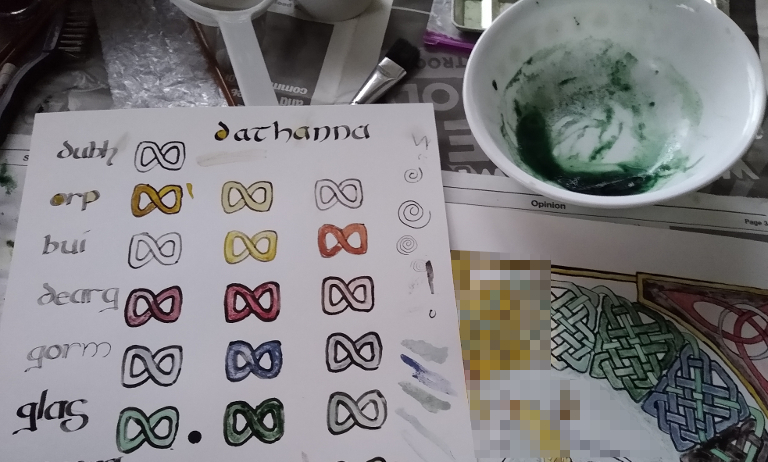
Months ago I made iris green and, because unlike verdigris, it would go bad, I froze it to use later. Now it was time to bring it out and let it thaw.
This turned out to be quicker than I thought. I was worried it might be too thin, but as it thawed, I realized the freezing had done may work for me. While some water remained frozen, I could pour off the green liquid that had a lovely concentration.
And it was green now, not dark teal, and certainly not purple. I had thought I might have to add a couple drops of water with soda ash to shift the color. But I didn't. It was green right out of the jar. And it flowed great. Not as smooth as the "gall" ink, but pleasant enough. I applied it with a brush and it went rather quickly.
Iris lake was also used for a darker, forest green. It would need to be mixed carefully like the other lake pigments.
In retrospect, I regret not making verdigris. My concerns about corrosion would have likely been mitigated by the thick paper being used. Certainly in the short term it would have been safe. Perhaps next time.
Dearg:


This was the moment madder was made for. Having figured out how best to mix a smooth pigment, I almost ruined it by rushing the process. The first madder I applied, the first lake of deep crimson, was grainy. I just stopped, let the mix sit and did something else for a while. When I came back, it was perfect. Then I ground and mixed the second lake of red and applied it. Things were coming along.

Gorm:
It couldn't last. Woad blue was turning out to be my personal nemesis. Try as I might, I could not bring the bright blue of the dye or the deep royal blue of the extracted indigo into a pigment of equal vibrancy on paper. After some reading, I heard about using indigo flower, the simmering "bloom" on the top of the indigo vat. As it happened, I was making small vats for another art project, so I just brought one in and used a brush to lift the bloom.
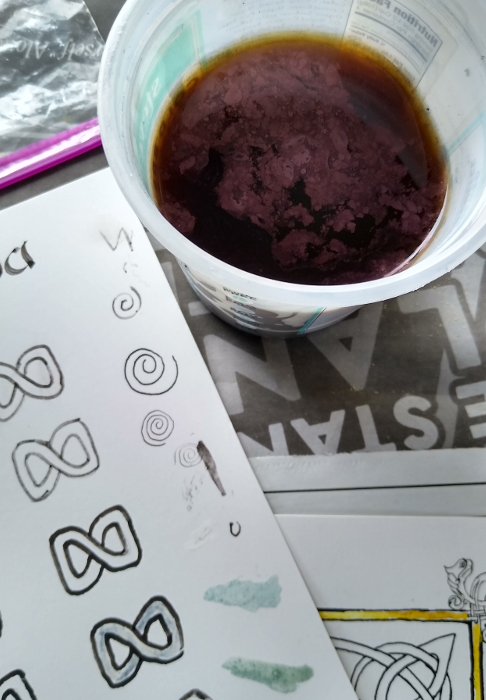

It's not an efficient process. I started to suspect that if I had mixed freshly extracted, still liquid indigo I would have had better results. It did make a bluish wash, a tint really, and was better than the earlier blue gray disaster. But it wasn't blue. Then I remembered the columbine lake.

This is what I used for the main patch of blue, painting over the indigo flower. I left a border untouched so one could compare the effect.
In another belated reversal of opinion, I think I should have left the indigo flower. It was subtle but more natural. I suppose if the columbine lake completely fades, the indigo will come back into it's own.


