Showing posts with label blue. Show all posts

Wednesday, October 7, 2020

Book of Kells Project: Applying Green, Red and Blue

  Glas:


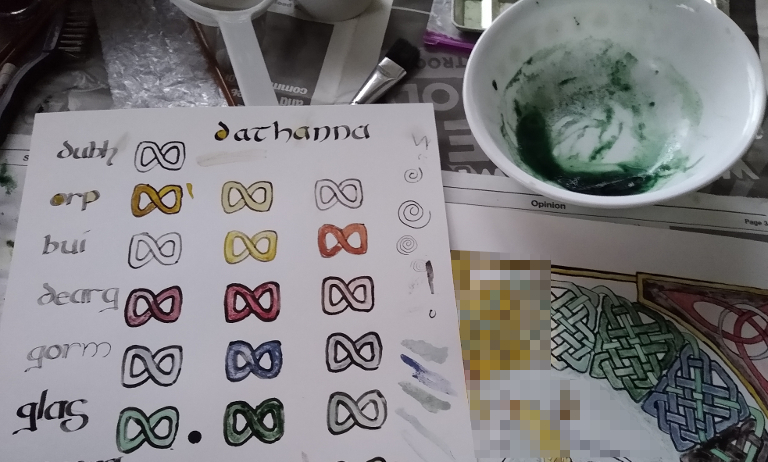
 Months ago I made iris green and, because unlike verdigris, it would go bad, I froze it to use later.  Now it was time to bring it out and let it thaw.

This turned out to be quicker than I thought.  I was worried it might be too thin, but as it thawed, I realized the freezing had done may work for me.  While some water remained frozen, I could pour off the green liquid that had a lovely concentration.  

And it was green now, not dark teal, and certainly not purple.  I had thought I might have to add a couple drops of water with soda ash to shift the color.  But I didn't.  It was green right out of the jar.  And it flowed great.  Not as smooth as the "gall" ink, but pleasant enough.   I applied it with a brush and it went rather quickly.

Iris lake was also used for a darker, forest green.   It would need to be mixed carefully like the other lake pigments.  


In retrospect, I regret not making verdigris.  My concerns about corrosion would have likely been mitigated by the thick paper being used.   Certainly in the short term it would have been safe.  Perhaps next time.

Dearg:


This was the moment madder was made for.  Having figured out how best to mix a smooth pigment, I almost ruined it by rushing the process.  The first madder I applied, the first lake of deep crimson, was grainy.  I just stopped, let the mix sit and did something else for a while.  When I came back, it was perfect. Then I ground and mixed the second lake of red and applied it. Things were coming along.


Gorm:

It couldn't last.   Woad blue was turning out to be my personal nemesis. Try as I might, I could not bring the bright blue of the dye or the deep royal blue of the extracted indigo into a pigment of equal vibrancy on paper.  After some reading, I heard about using indigo flower, the simmering "bloom" on the top of the indigo vat. As it happened, I was making small vats for another art project, so I just brought one in and used a brush to lift the bloom. 
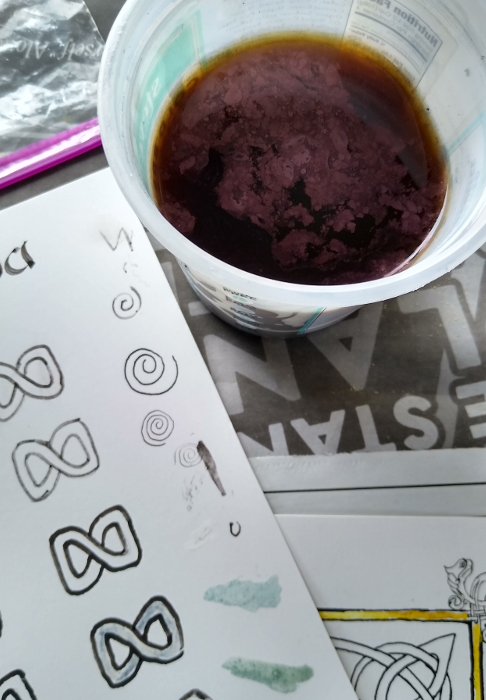


It's not an efficient process.  I started to suspect that if I had mixed freshly extracted, still liquid indigo I would have had better results.  It did make a bluish wash, a tint really, and was better than the earlier blue gray disaster.   But it wasn't blue.   Then I remembered the columbine lake. 


This is what I used for the main patch of blue, painting over the indigo flower.  I left a border untouched so one could compare the effect.  

 In another belated reversal of opinion, I think I should have left the indigo flower.  It was subtle but more natural.  I suppose if the columbine lake completely fades, the indigo will come back into it's own.


Wednesday, May 20, 2020

Book of Kells Project: Back up Blue

I did it on a whim and I didn't regret it:  a lake of deep blue columbine.


It wasn't something planned.  I stumbled across a great mass of flowers in a public area near a local park and thought, "why not?"

I actually grow this flower.  It's a rich royal blue, almost purple, columbine.  My plant, and it's daughter plants, was a volunteer at another local park that kept getting mowed down until I rescued it in the dead of night.  It's not a native plant so I was helping, right?

 Anyway, after getting lake pigment extracting down to a competent level, I was on the look out for newer materials.  I started looking at flowers thinking, "What color could you produce?"  


Now my columbines don't produce masses of flowers.  Just enough to be a splash of color in the shade garden.  But there were so many of this stand, I could easily pluck a handful for a test lake batch without striping them.  As a general rule, unless it'd a dead common plant, like dandelion, never take more than you need, and always leave some to carry on.

Now most of the plants I experimented with, when laked, produce a color that shifts a little or significantly from the original.  Blue iris goes green. Red Rhododendron goes purple.  Even madder shifts to a different red.  A mullein lake came out sunny yellow, but yellow dye plants are generally strait forward that way.  Blue dye plants have no such reputation.  Woad and indigo are dark green and both require extensive processing to extract the blue bits.


Not so with this columbine.  When dried, it made a nice medium blue.  


This isn't to say one could dye with it.  Only it made a beautiful blue pigment that probably is not lightfast.  But if I need a natural bluey blue I know I have it.  I even made a second lake which produced a pale blue, perfect for sky.   


Sunday, February 23, 2020

Book of Kells Project: Woad pigment

 Woad pigment was used in the Book of Kells.  I wasn't too surprised.  Woad was used for blue dye since, well, prehistory probably.  It is said Celts tattooed themselves blue or painted themselves blue with woad.  But this is now being called into question for many reasons.  However, anyone who has used a woad vat would notice a blue scum does collect at the top and it seems perfectly plausible this could be used as a simple pigment.

Extracting indigo pigment from woad turns out to be much simpler than dying with a woad vat.  With a healthy plants, good soil and the right equipment, you can process and wash indigo pigment in a handful of hours. 

First the fresh first year leaves(*) are picked and thrown into boiling water. As soon as they are all in, I turned the heat off.  There is a fine balance between hot enough to extract but too hot and damaging indigo precursors.  I took it off the heat, put a tight lid on, and moved the pot to cool on bricks outside of the house.  


Once it's cool enough to handle(a couple hours or more), I squeezed the faded spent leaves, and strained the liquid.  It should be a lovely warm russet reddish brown.  This is full of indigo precursors.  Now some people use beaters or pour the liquid back and forth between containers, or a blender.  Personally, I have things to do so I go strait for the Vitamix. 

Pour the whole thing in, add a teaspoon or more of soda ash, and mix.

Use the lowest speed for a couple of seconds, until everything is mixing around, then take it up a quarter until you have a nice vroom and everything is getting frothy.  Don't go too high or too long, or the indigo will all land on the top of the foam and take forever to settle.  When you see spots of blue on the top of the foam...no more that 15 to 20 seconds...you're done.


You will be able to see the indigo falling to the bottom, in the dark greenish blue liquid as "swirlings", but it'll be too dark to see the pure blue until it's washed.

Let it sit for half and hour to and hour, however long it takes for the liquid to settle and most of the foam to disappear.  

Now you have to be careful.  The liquid is too dark to clearly see the indigo sitting at the bottom, though you may see some if you shine and very bright torch right up against the glass.   Because you can't see it, you have to CAREFULLY and SLOWLY pour half the liquid out(you can save this to lake  if you want to).   If you fumble, you have to put it down and let it settle again.  The indigo is so fine, once disturbed it is float freely, happy to escape down the drain!   Once you get practiced you have a good idea how far you can go.


Now add clean cold water to the jar filling it up, and let it settle again.  At this point you can barely see the slightly darker mass at the very bottom.  Usually no more than a quarter inch unless you have very healthy plants.  Repeat the process.


Now the liquid is a medium transparent green and the indigo is clearly visible.  Depending on technical skill and fine motor control, you can cut down your washing time significantly once you have an idea of how fast you can pour without losing indigo or cause backwash.  Once the water in the large container is a very pale green tint, you can transfer the indigo to a smaller container to wash.


You want to wash it until the water is clear and the indigo is a deep dark blue.  It will be the bluest natural blue you have ever seen, like a deep lake under a clear sky.   

Once the water is clear, then it needs to be poured and siphoned off.  Turkey basters and pipettes help.  When the indigo is in a small container with only an eighth inch of water, then it can be poured onto a glass plate or other non reactive flat surface to dry.  


Indigo is supposed to produce, once ground with binders and water a dark navy blue, not as spectacular as the deep blue dye. But at least it's blue.


*Most sources insist one use first year leaves.  But my plants are deciding they are perennials...after flowering, they put out new leaves from the roots and they are the same quality as "first year leaves". They should be soft, slightly hairy, green with the purplish stalk.   I don't know why my plants are deciding to be immortals, but I'm not arguing as long as they keep the blue coming.