Showing posts with label madder. Show all posts

Wednesday, October 7, 2020

Book of Kells Project: Applying Green, Red and Blue

  Glas:


 Months ago I made iris green and, because unlike verdigris, it would go bad, I froze it to use later.  Now it was time to bring it out and let it thaw.

This turned out to be quicker than I thought.  I was worried it might be too thin, but as it thawed, I realized the freezing had done may work for me.  While some water remained frozen, I could pour off the green liquid that had a lovely concentration.  

And it was green now, not dark teal, and certainly not purple.  I had thought I might have to add a couple drops of water with soda ash to shift the color.  But I didn't.  It was green right out of the jar.  And it flowed great.  Not as smooth as the "gall" ink, but pleasant enough.   I applied it with a brush and it went rather quickly.

Iris lake was also used for a darker, forest green.   It would need to be mixed carefully like the other lake pigments.  
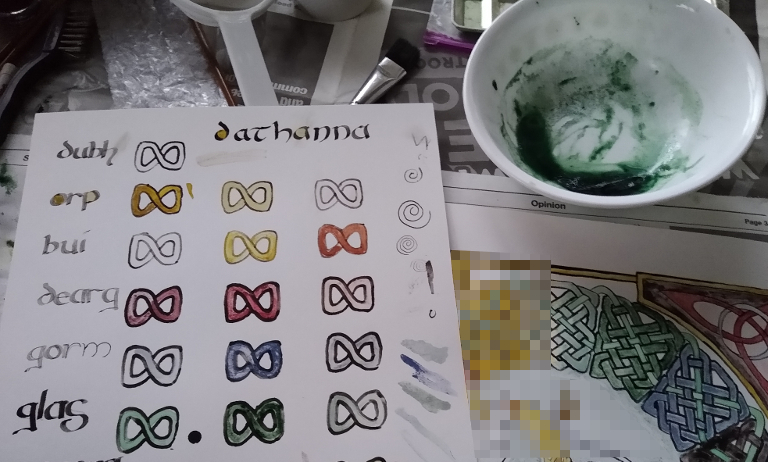


In retrospect, I regret not making verdigris.  My concerns about corrosion would have likely been mitigated by the thick paper being used.   Certainly in the short term it would have been safe.  Perhaps next time.

Dearg:


This was the moment madder was made for.  Having figured out how best to mix a smooth pigment, I almost ruined it by rushing the process.  The first madder I applied, the first lake of deep crimson, was grainy.  I just stopped, let the mix sit and did something else for a while.  When I came back, it was perfect. Then I ground and mixed the second lake of red and applied it. Things were coming along.


Gorm:

It couldn't last.   Woad blue was turning out to be my personal nemesis. Try as I might, I could not bring the bright blue of the dye or the deep royal blue of the extracted indigo into a pigment of equal vibrancy on paper.  After some reading, I heard about using indigo flower, the simmering "bloom" on the top of the indigo vat. As it happened, I was making small vats for another art project, so I just brought one in and used a brush to lift the bloom. 
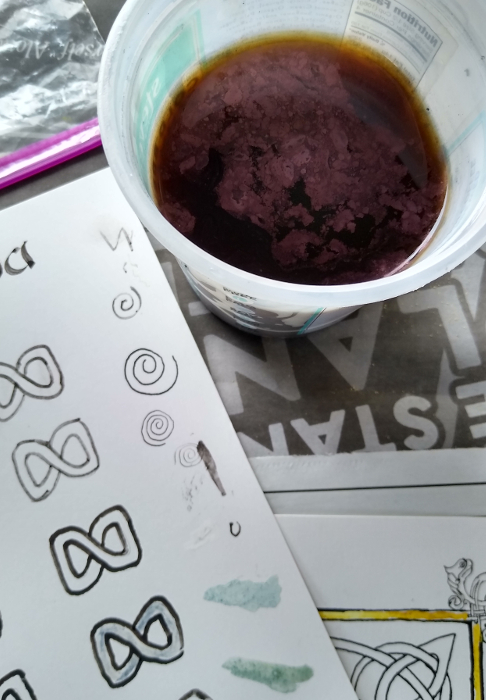


It's not an efficient process.  I started to suspect that if I had mixed freshly extracted, still liquid indigo I would have had better results.  It did make a bluish wash, a tint really, and was better than the earlier blue gray disaster.   But it wasn't blue.   Then I remembered the columbine lake. 


This is what I used for the main patch of blue, painting over the indigo flower.  I left a border untouched so one could compare the effect.  

 In another belated reversal of opinion, I think I should have left the indigo flower.  It was subtle but more natural.  I suppose if the columbine lake completely fades, the indigo will come back into it's own.


Monday, March 30, 2020

Book of Kells Project: Red That Might Have Been

In the Book of Kells, the pigment confirmed to be used as red is red lead. 

Red LEAD.  We're not going that.

But let's explore this pigment choice. Why didn't they just use madder? 

Madder was known and grew throughout Europe.  The laking process was technology easily available to monks.   And madder is the truest natural red.  And, perhaps as important, I grow it and really wanted to use it in something cool and interesting.  

Now the Renaissance painting masters used Madder Lake, but this is not rocket science (Philosopher's Stone Level Alchemy?) even for the Middle Ages.  True, of the lake colors, madder can be the fiddliest to get right, but this just takes time and honesty, what monk doesn't have loads of time?   

I really didn't want to use Amazon to hunt down a safe(maybe?) form of red lead when I had madder growing in the front yard.  What would a monk do?  Surely they would use what they had at hand before seeking exotic and dangerous imports(to be fair, they probably had no idea how dangerous lead was).  And with that excuse, a maddering I went!


Madder, or Rubia tinctoria, is the go to dye plant for true natural reds.  Altering pH can alter shades, but, except maybe for purple/violet, why would you? There are many online resources to dye with madder, but few to get pigment.   We're all rather stumbling around in the dark ages of the future trying to recreate the past.

Except for the top of the line pigment produced by Kremmer.  But they don't count, showoffs.

Continuing to stumble around in the dark, the best resource I found was a violin forum, Maestronet .   Madder lake is apparently used in traditional varnishes.  Between this forum and several scientific and historical reconstruction papers, I was able to cobble together a tentative plan...

Step 1: plant madder seeds.  

Step 2: wait three years.

I'm not just being cheeky.   I planted my plants almost four years ago as part of the herb, medicine, dye and historical plants garden.  I have dyed with madder in small batches and it is so handy to have it right out there.   Ideally one digs up roots at the end of the season, though these I dug up early spring.  YOu can even root up small amount in the middle of the year for test projects.  And if you dye with a traditional stinky woad vat, madder helps the fermentation process. But for best results they should be allowed to grow mostly unmolested for at least three years.


After digging the roots up, I washed them thoroughly.  Many sources stressed this as essential to get a good clean bright red.   Of course by "wash thoroughly", I just let them sit in water for most of the day, then swished most of the dirt off.  After a through rinse in the sink, I cut the roots up into small pieces, then put them in a jar filled with water and a large slash of vinegar and let them sit a week.


By that time the roots should be waterlogged and settled.  One can heat them to try to extract more pigment, but one risks shifting the color to orange if the pot gets too hot.  Playing it safe I stuck with the cold extraction.


I strained the liquid, removing the roots, and added the soda ash.  This is different from other lakes in that alum is added first.  I'm not sure if it matters, but I'm taking chances with a once a year harvest.  I trust the lads( and lasses) at the violin forums know there business!        


From dye pots, I know adding the soda makes the color more vivid, but the water was so dark crimson, one couldn't tell.  Then I added the alum, and the color shifted, and, as lakes do started to congeal...very, very, slowly.  One has to be patient, but with experience one can see when it's happening very slowly, when it's not happening, and what careful corrections one should take.   


In this case, after the first panic of it either not working or turning pink(utter death for a varnish), I was pleased that not only had it worked perfectly, but I had some of the highest quality sought after crimson one could make. 


After settling, it must be strained by a very fine coffee filter.  Then scrapped off onto a glass or nonreactive metal surface to dry.


It dries almost black.  I assume in grinding the red comes out again.


Well, looking  at the abundant red left in the water, I saved to to make a second lake.  That was so smart because I was able to get a stunning fire engine red.  

This was very satisfying.  Another lovely thing about madder dyes and pigments is they are, if not colorfast, then extremely resistant to fading.  Of course nowadays  alizarin, the red chemical in madder, is synthesized, a much less magical process.   I'll stick to my madder patch while I have it.


Saturday, February 29, 2020

Making Lake Pigment

 I came across lakes while trying to find a way to make natural red pigment.   I'd already dyed with madder in the past, but simply powering the root doesn't work.  I wasn't even sure if madder would be the best choice.  Then I discovered Madder Lake.

It has no coverage, that is, it can't be used by itself to just cover up a color, but it is red, it is natural and it does work. 

Laking can be done with almost any plant  that has enough strong coloration to make pigment.   In the simplest terms, a "lake" is using a chemical reaction with alum and some base, lye, chalk or soda ash, to bind the colorants in a stable form.  Most lakes are made by soaking or boiling the plant material until a dark pigment saturated liquid is made.


Then one dilutes alum with a small amount of water and adds it to the pigment.  Often, though not always,  there is a color shift, usually to a richer more saturated hue.  But sometimes the liquid is just too dark to tell.  To this alum mixture is then added a diluted base.  Sometimes, like with chalk, there is a vigorous reaction. But usually there is just an interesting, but not messy, swirling of the contents as the alum and base bind together.   

Proportions are important: too much of one or the other and the color is weak or pastel.  Or their is a lot of whitish debris that increases washing time.  Generally more alum is used than the base, but exact proportions vary on the kind of base.

Once the reaction is complete, the liquid will be filled with a colloidal solid.  This will take a while to settle, often hours, if not a couple fo days depending on the pigments involved.  After it settles, it's washed, that is the liquid is poured off consecutively until the water is clear and the settled solid can be strained and dried.   One can also save the first pour off to make another, paler, lake.   

This opens up a wealth of natural pigment possibilities.   But their are caveats.  Many plant based pigments are not colorfast.  There are exceptions: madder, weld, woad. Really anything that has a reputation as a colorfast dye will probably make a colorfast lake.  The color will be different: madder is pleasantly true red but woad becomes a dark teal.   The advantages of lakes, once they are dry, is they can be stored indefinitely, though one probably should keep them out of direct light.  When one was ready, they were ground and mixed with water and gum arabic to make a water color, or ground into oil for oil paint.


So this was exciting.  I could, in theory make pigment out of anything.  But I discovered this is February, when few plants are available.   Then I remembered the dye baths I'd saved.

There was a lot of mullein  and a medium jar of madder.  They were stored in a cold place in the garage and hadn't fallen prey to mold.  So I experimented.  It turned out to be the best thing, experiment with old dye baths.   Mistakes could be made that would have made me very sad with fresh, high quality madder roots.  Like when it when pink, for instance:


According to these forums pink madder is the worst.  I'm not a fan of pink, so I tend to agree.  The whole point of madder is making red.  But pink is a useful pigment  to have on hand, so lemons, lemonade, etc.

My drive was an inspiration for a Book of Kells project where I'd use just natural pigments.  Learning to lake pigments made that idea possible.