Sunday, February 28, 2021

Gearrscéal: Naoi Bhfocal, Ón Taobh


Naoi Bhfocal, Ón Taobh

Nine Words Sideways

(scéal i mBéarla agus i nGaeilge)


Ann lived alone. Usually she didn’t mind, but she missed her friends, most who had moved away after school. She had very little in common with her coworkers. Her job was a dull, but it paid well so she was disinclined to leave. The pay also allowed her to indulged her interests, particularly books, of which she collected many. Among books on sailing, gardening and history, she had kept books from her childhood. One in particular was her favorite, a book on fairy tales. She’d read and reread it so many times she knew it by heart.

But a part eluded Ann, an inscription in the front, printed in an old script. It read:


Say this with your eyes shut

Motuigim bolah an Eireannaig binn breugaig faoi m’foidin dutaig

And you will see what you will see.


Now and then over the years Ann would return to it, searching for clues, first at the library, then online. She learned it was in Irish. One forum dedicated to Irish language had decoded the letters into something slightly more readable. But it took Ann the better part of an afternoon of research to get an approximation of what it might mean and still she wasn’t sure. “Feeling the soul of Ireland” ? It was garbled through culture and time. As for how to say it, no one really knew.

A curiosity had taken root. Ann didn’t know why. She wasn’t Irish(that she knew of). But a desire to solve this one mystery from her childhood drove her on. She found a transliteration into modern Irish. She muttered this to herself as she read it, as best she could, and a something inside her changed.

Work was the same, but more dull. Ann thought more of taking a course and changing professions. But the words were ever in her mind. She muttered them in the morning after rising, and in bed at night. Even on the bus to and from work. With every thought, the words sank deeper into her, pressing their form on her soul, morning, noon and night.

Like the hacker tool ‘brute force’, Ann seemed to be trying every combination until one worked. There is a limited number of ways to pronounce these nine words, so it was just a matter of time before she said it right.

It happened one morning while she was brushing her teeth. The sounds she’d struggled with, were, if not perfect, intelligible to the people of the time who wrote it down. And, in that moment, she squinted enough that her eyes were, for the most part, shut.

Something inside Ann moved again. She felt the light change. She blinked.

And ansin....feiceann Ann timpeall. 

Taitníonn an ghrian tríot an fhuinneog. Bhí scamaill beacha os cionn an rósóg in airde taobh amuigh. Ach, bhí rud eile ar na rósanna: léimeann na créatúir bídeacha óir le sciatháin ó gach peiteal sa ghrian. Sióga óir a bhí iontu.

Dhún Ann a súile. B'fhéidir, bhí sí fós ina codladh, ag brionglóid. D’oscail sí a súile. Taitníonn solas na gréine isteach sa seomra folctha anois. Tháinig cúig sióga óir leis, ag damhsa ar an doirteal. Bhí siad go hálainn, ach bhí sí buartha go raibh sí as a meabhair. Chuala sí canadh freisin: “Blah, blah, blah”. Tháinig se seo as na sióga óir nuair a bhí siad ag damhsa. Tharraing Una anuas na dallóga, ag coinnigh an solas amach. D'imigh na sióga.

Chan siad taobh amuigh fós. B'fhéidir, dá ndéanfadh Ann neamhaird orthu, rachaidh siad imigh. Bheadh sí an-mhall. Chaith sí uisce ar a aghaidh. Mar a thriomaigh sí í féin, bhuail duine éigin ar an doras seomra folctha.

Stán Ann ar an doras, le huamhan. Bhí sí ina cónaí sa teach léi féin. An buirgléir a bhí ann? Cén cineál cnag buirgléir chun an seomra folctha a úsáid?

“Brón orm,” a dúirt guth, “An mbeidh tú i bhfad?”

Go tobann d’fhág an eagla í. Rug Ann ar na pionsúirín géar (ar eagla na heagla) agus tharraing sí an doras a oscailt.

Sheas fear óg tanaí ard os a comhair agus an-chrosta. Chaith sé jíons teilgthe agus t-léine a léigh, “Bua T-nOg”. Bhí súile glasa aige agus gruaig fhada dhubh air. Bhí dhá adharc gabhair ar a cheann aige freisin, agus bhí scairf a d’athraigh dath aige. Ar dtús bhí sé glas, ansin ór. Ansin bhí éisc ag snámh air, amhail is gur teilifís a bhí ann.

“Ní tusa an t-aon duine atá ina chónaí anseo, tá a fhios agat,” a dúirt an fear.

Thit na pionsúirín as a lámh.

Chrom an fear, thóg sé iad den urlár, agus thug sé ar ais do Ann. Shnámh na éisc ar a scairf go dtí na foircinn, ag beathú amhail is dá mbeidís ar bhun locha.

“Anois, mura miste leat ...” a dúirt sé, ag brú anuas uirthi agus ag dúnadh an dorais.

Níor chreid Ann é. Mura raibh a meabhair caillte aici, geas a bhí sna naoi bhfocal. “To see what you will see”. Shíl sí go tapa: an féidir léi é a aisiompú?

Rith Ann go dtí a seomra leapa. B’fhéidir go ndúirt an leabhar rud éigin níos mó. Ach bhí an leathanach leis an inscríbhinn bán.

Bhí sé mar an gcéanna lena leabhar nótaí. Bhí gach leathanach leis na naoi bhfocal bán. Chuardaigh Ann a fón. Ní raibh na focail ina stair chuardaigh. Fuair sí an fóram céanna. Ach bhí an snáithe imithe. Cibé draíocht a thoghairm, bhain sí iad ó gach cartlann, téacs nó digiteach.

“Nah, níl ach cinn a d’úsáid tú,” a dúirt an fear. Bhí sé ina sheasamh sa doras, ag triomú a adharca le tuáille. “Níl sé uait níos mó.”

“Cad é?” dúirt Ann.

“Breathnaigh!” a dúirt sé , dhírigh sé ar amach an fhuinneog. “Is breá leis na sióga gréine na bláthanna.”

“Bláthanna?” macalla Ann, ag breathnú taobh amuigh. Gan dabht, rince na créatúir sióg ar na rósanna, na lus móra agus fiú an féar.

“Nach gcloiseann tú iad? ‘Bláth, bláth, bláth’. Sióga gréine. Leanann beacha iad.”

“Ar ndóigh déanann siad,” a dúirt sí, “Ceist amháin.”

“Cinnte.”

“Cé sa diabhal atá tú agus cén fáth a bhfuil tú i mo theach?”

“Mise Troscán. Tá mé i mo chónaí san áiléar.”

“Níl áiléar agam!”

“Ní raibh tú in ann a fheiceáil roimhe. Tá sé ón taobh.”

“Ón taobh?”

“Le domhan an duine. Bhíomar anseo i gcónaí. Anois is féidir leat a fheiceáil. Nach é sin a bhí uait? ”


JMCressy©2021


Notes:


Bhí mé ag triail an scéal seo a chríochnú do “Splonk” ag deireadh mhí Feabhra. Bhí 1,700 focal aige agus teastaíonn níos lú ná 500. Tar éis sé uair, tá 1000 focal aige. Is gearrscaeal é, ach níl sé an-ghearr. Mar sin, chuir mé é ar mo bhlag. Bhí sé cleachtach maith agus is é an chéad scéal a scríobh mé le Gaeilge ann.

Má rinne mé botún… agus rinne mé go cinnte...abair libh.

This is part of a series of Modern Fairy Tales I work on in between other projects.

Inspiration for this particular tale goes to book with the real inscription, in “Celtic Fairy Tales” , collected by Joseph Jacobs and published by John Nutt in 1892. Sadly, that page in my copy isn’t blank.


 ~~~

Scéalta le Ann agus Troscán

1: Naoi Bhfocal, Ón Taobh  (Ar dtús i mBéarla)

2: Bainne na nÓg

3: Rialacha an Tí


Tuesday, December 29, 2020

Nollaig Shona Daoibh!

Tá mé an-mhall an bliain seo....


pioc cárta ... aon chárta


Christmas cards finally sent...better late than never!


Monday, October 12, 2020

Book of Kells: Finished, Submitted

 At long last, it's done.

But I cannot publish the finished art because of the rules of the contest. I can publish the  low resolution color test sheet, with all its mistakes and scribbles:


What I learned: those monks are metal. Even limiting myself to natural materials and the morning light, I still had the advantage of central heating and food security.  And modern conveniences.  If poor Brother Cadfael  wanted a hot cup of coffee, he had to wait for the Renaissance.  Tea wasn't much better.  Whatever hot drink...herbal tea, beer, wine...it would have been a hassle to heat it up.  There was no microwave in the scriptorum!  

While I succeeded in creating colors from all natural sources ( to which some pedant will say: "Actually, petroleum is a natural source".  Dun do bheal!), I completely failed at even coming close to a majority of the original pigments.  Historical pigments used:

Gall Ink

Indigo 

And that's it.

Now if I was to expand that to pigments documented to be used in the Middle Ages, we can add:

Iris Green

Zinc

Any lake puts us in the Renaissance.  Sticking to known medieval practices, the best I could say is 4.  But all natural sourced... that is, what a monk or medieval artist could make with the materials and technology of the time.

Here's the color sheet with source pigments labeled:


As for the contest, feicfimid.

.


Thursday, October 8, 2020

Book of Kells Project: Border, Washes and Finishing Touches

After all the main elements were finished, some details required creatively mixing color.   

Orange/Oráiste

This color is conceptually a modern invention.  It isn't that the ancient Irish didn't see orange.  Linguistically they just considered it a type of dark yellow. There's some very interesting documentation about how different languages develop words for colors depending on their lifestyles, the cultural importance of the color and it frequency or rarity.

Even in English the word for "orange" is the same as the non-native fruit, implying in the original Anglo-Saxon we also thought of "orange" as a kind of yellow or gold.  The point being I needed ORANGE for a design element. And so I did it the typical way and mixed  red and yellow, or rather, some madder lake and tansy lake.  


It was a reasonable result, pretty if not authentic.

Around this time I also mixed up the mullien lake, made without chalk.  I wanted a  less opaque yellow for some details.


Pink/Bándearg:

I actually had some pink madder lake I could have ground up.  But the zinc and madder lake were still available and I was tired out with grinding.  So I made a mix with a little water to wash and detail a background.

Grape Hyacinth and Bluebells inks:

I did not freeze these like I did with the Iris Green. That was a mistake.  I did add alcohol, thinking that would be enough to preserve them.  While they did not mold, or otherwise physically degrade, their colors suffered.  The grape hyacinth was no longer purple or even lavender, but a weak yellowish green. Ditto for the Bluebell Ink, that also lost it's magical two tone quality.

Nonetheless, these are colors useful to tint backgrounds. See, as the art was finishing, I was noticing how very BRIGHT the background was compared to the art in the Book of Kells.  This is down to using vellum and the age of the vellum.  Considering the quality of the lighting at the time, the monks would probably have preferred a bright white background if they could get it.  But stylistically, it was too much so I was looking for something to dim it, just slightly.  These inks served well.

There was also mixing and blending for small details, like madder lake and zinc to make a silvery white for the moon.

"Crottle:

This lichen ink was also a useful background wash, mainly for the snakes.  Of all the washes it came the closest to imitating old vellum.  Maybe I should have used it from the beginning.

Book of Kells Project: Donn with Chestnut

 It's a very bad pun.   

"Donn" is Irish for brown and sounds like "down" in some dialects.

Yep.  Ní duine greannmhar mé.  Moving along...

Chestnuts are a staple I forage for in the fall.  I use them in stews, cakes and stuffing.  When boiling them during processing, the liquid was always dark brown.  Surely this could be used for ink or something, right?

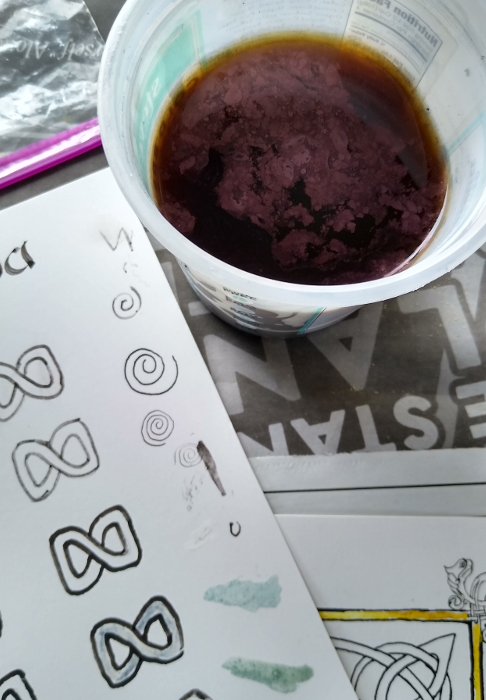
Well, yes. Any nut with tannin can be processed with iron salts to produce ink.  Chestnut is less dramatic than oak galls or acorns, but it does work.  The color isn't black, but a warm dark brown.  Which is useful when you need brown.


Chestnut ink was a nice accent.  It also served as a substitution for the lack of any purple from the orchil disaster.  Really would have liked that...

As an aside, dark brown in the manuscript is attributed to iron gall ink.  But I wonder if this just isn't age or a reaction with the vellum substrate?   Because my oak tannin based ink is BLACK.  But I could imagine it might shift tone with age.  


Wednesday, October 7, 2020

Book of Kells Project: Applying Green, Red and Blue

  Glas:


 Months ago I made iris green and, because unlike verdigris, it would go bad, I froze it to use later.  Now it was time to bring it out and let it thaw.

This turned out to be quicker than I thought.  I was worried it might be too thin, but as it thawed, I realized the freezing had done may work for me.  While some water remained frozen, I could pour off the green liquid that had a lovely concentration.  

And it was green now, not dark teal, and certainly not purple.  I had thought I might have to add a couple drops of water with soda ash to shift the color.  But I didn't.  It was green right out of the jar.  And it flowed great.  Not as smooth as the "gall" ink, but pleasant enough.   I applied it with a brush and it went rather quickly.

Iris lake was also used for a darker, forest green.   It would need to be mixed carefully like the other lake pigments.  


In retrospect, I regret not making verdigris.  My concerns about corrosion would have likely been mitigated by the thick paper being used.   Certainly in the short term it would have been safe.  Perhaps next time.

Dearg:


This was the moment madder was made for.  Having figured out how best to mix a smooth pigment, I almost ruined it by rushing the process.  The first madder I applied, the first lake of deep crimson, was grainy.  I just stopped, let the mix sit and did something else for a while.  When I came back, it was perfect. Then I ground and mixed the second lake of red and applied it. Things were coming along.


Gorm:

It couldn't last.   Woad blue was turning out to be my personal nemesis. Try as I might, I could not bring the bright blue of the dye or the deep royal blue of the extracted indigo into a pigment of equal vibrancy on paper.  After some reading, I heard about using indigo flower, the simmering "bloom" on the top of the indigo vat. As it happened, I was making small vats for another art project, so I just brought one in and used a brush to lift the bloom. 


It's not an efficient process.  I started to suspect that if I had mixed freshly extracted, still liquid indigo I would have had better results.  It did make a bluish wash, a tint really, and was better than the earlier blue gray disaster.   But it wasn't blue.   Then I remembered the columbine lake. 


This is what I used for the main patch of blue, painting over the indigo flower.  I left a border untouched so one could compare the effect.  

 In another belated reversal of opinion, I think I should have left the indigo flower.  It was subtle but more natural.  I suppose if the columbine lake completely fades, the indigo will come back into it's own.


Book of Kells Project: Grinding and applying pigment 1

 Earlier in the year, when I'd first extracted indigo pigment and made the first lakes, I was so excited.  All I had to do was grind them, mix them with gum and water, and I would have homemade paints.  Yay! Bhí an-sceitimíní orm...

About that...

The experiment with indigo was less than satisfying but instructive.  

Firstly, indigo doesn't grind down and mix into the lovely blue that one expects from dying.  At best, it makes a navy blue grey.

Secondly, it was grainy.  I thought I wasn't able to grind it finely enough, even though I bought a chemist mortar and pestal for this purpose. That was part of the problem.  But I was to find out the method that worked for me was to grind it as fine as possible, WITH gum arabic, then mix a little water and alcohol, grind it some more, then let it sit for 15 minutes to a half an hour.  THEN grind mix it once more to ensure consistency, adding a little water if needed.

This is not the method used for traditional oil paints.  The pigments used in the Book of Kells are all in the category of water colors: a finely ground pigment, with a binder and water. It's simple, but requires some practice.


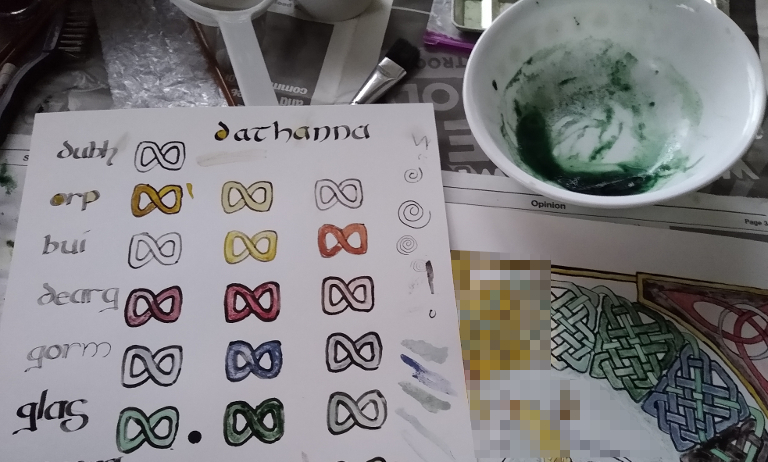
Taking the lead from unfinished pages in the manuscript, after inking, I applied the false orpiment.  Both the laked tansy and laked mullein produced workable paint with minimum of fuss.   After testing them both, I decided tansy made a better orpiment substitute.  Regretfully, I was never able to grow enough weld in time to experiment with laking it.  Perhaps next year.

Next, I made some washes with the pale blue lakes, woad and columbine, as a back ground to the center piece.  These were much less satisfying, being grainy and uneven.  This was where I started to let them "soak" a bit.  Fortunately they are pale and give a rough textured effect which, while unwanted, is artistic in it's way. 

The zinc white was extremely easily to work with.  It also doubled as a sort of "white out" if used in very small doses, to cover minor smudges.   It neither has the coverage of real whiteout, nor do any of the pigments have 100% coverage, so one really must plan to be as careful  as  a monk in a scriptorium with nothing else to do.

With the center and "gold" highlights done, I was ready to fill in the rest of the colors.