Monday, August 10, 2020

Book of Kells Project: False Orpiment - How Not to Die of Lead Poisoning

Orpiment is Lead Sulfide. It was used to make beautiful rich yellow gold colors.  It is also deadly poison.   I'm sure some monks had an idea one needed to be careful...it was no accident that only the scriptorium monks seemed to go a bit funny faster than everyone else in the monastery.  But they probably had no idea what exactly was making them go off.  Lead poisoning takes a while.  And since we don't have records of monks becoming violently impatient or severely intellectually damaged, presumably they were more careful that we expect, if only not to waste some of these valuable ingredients.

I was willing to experiment with the real thing which you can get.  But only in a premixed liquid form.  Alas, all that was available were powers which I had no confidence I would be able to regularly handle safely.  That would take cleanroom care and I know I can't be bothered.   If it was a liquid in a tube, I could easily segregate and dispose of brushes etc.  But mixing lead sulfide dust?  Nope.



What to do?   I restricted this project to natural pigments, maybe not exactly the ones monks used, but things they could have used.  And I don't want to cheat.  I feel paper is a reasonable cheat, calves skins being hard to come by.

So read up on all the well known yellow pigments of the old masters.  

Indian Yellow seemed nice.  Ah, but it involved mango leaves and animal abuse.  Really.  It's pretty awful if this is accurate.   There is a modern substitute which would do in a pinch, but I was unenthusiastic.

There are some  bright ocher yellows, but lets not kid ourselves.  Colored soil is not going to approach the vibrancy of orpiment.  I'd rather use yellow.

That brings us to plants dyes, specifically laking plant dyes.   I'll have a laking post soon(link).   There were a couple of good subjects by color.  Saffron was too expensive...any saffron I'm going to cook with!...but there was turmeric.

Turmeric makes a bright yellow, and there was plenty about because I use it for egg dying in the spring.  So I laked it, just so I had something if nothing better came along.

Problem is turmeric is fugitive...it is not colorfast and fades rather noticeably after a year, in even indirect light.      Next up: mullein.


Mullein makes a nice pastel yellow dye on cloth. So I wasn't to eager to waste my time laking it.  The other problem with lakes is they are semi transparent, that is they have no coverage power.  I was already figuring I'd use zinc as an undercoat.  Then I read somewhere weld...the go to yellow dye of the middle ages...when laked and precipitated on chalk, could be as brilliant as orpiment.

That's when I decided, okay, okay, I'll buy weld seeds!  Up until then I thought weld was over rated.  Yellow dye plants are really easy to find.  But weld is the most colorfast natural yellow.   So fine, I would try laking weld on chalk.

But it would take a while to arrive and mullein was in the garden.  I'd already done a lake of mullein. And I was shocked and pleased it was a much brighter yellow than it dyed fabric.   So may as well try out the process before the weld arrived.


Laking on chalk is very similar to regular laking: instead of lye or soda ash, you add the chalk mixed in water, but in a slightly higher proportion.  Instead of the alum and ash binding with pigment to make a colloidal fluid mass, the alum and pigment bind to the chalk and fall to the bottom...eventually. 


 WARNING: Do this over a sink.  The container must be at least twice as large because the reaction, while not explosive, is vigorous.  It foams up to twice its volume, before eventually calming down.


Once the mixture stops being a drama lama, it needs to be washed, much like extracted indigo(link).   You cannot depend on filters to make your life easier, unless you have the finest top of the line chemical supplies.    Really, once pigmented chalk is poured out to dry, it loses water pretty fast, unlike indigo which takes it's time.


 This could work.   Then the weld seeds arrived and I was so excited.


Turns out starting weld is bloody fiddly.  If I had time and room in the garden, I could experiment.  But I know I'm working with a hard deadline.    I want to be painting and lettering by the end of summer and the seeds came in early July.  They take two weeks to germinate.  The prefer partial shade, though the need light to germinate.  It's never easy, is it?

First three plants germinated adequately.  Then, all but one died from too much sudden sunlight in their pots.  The survivor was moved to a north window.  It's hanging on gamely, but not large enough I feel safe putting it anywhere outside.

I start another pot.  Two more germinate.  It's looking good.  Then, suddenly, at the end of the day, one just gives up an falls over.  Cop on!  This is a vigorous weed that grows throughout Eurasia!

There's nothing for it.  I have to accept the weld might not come through in time.  The survivors are still in pots, now outside on the back ...shaded.. porch.  In the meantime I experimented with the other yellow herb on the property: tansy.
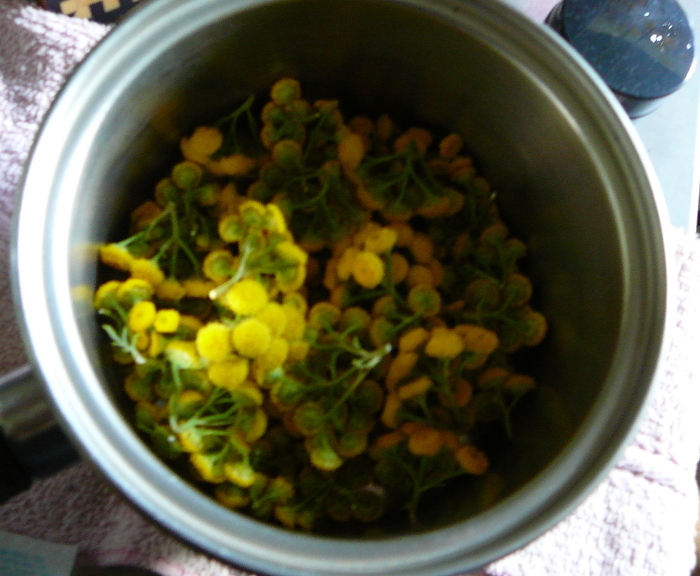


I grow tansy--along with mugwort, vervain, and feverfew... as a digestive bitter.  And it's flowers are YELLOW.  Oh boy, are they yellow.   So trimming only flowers...no leaves need apply....I boiled them per the usual laking method, added alum, then the chalk...and forgot about the vigorous reaction.


It was very amusing.  I was able to act fast, save all the mixture by quickly pouring things into larger containers.   


Except for that bit of excitement, it was quite a success.  Really, the color looks more gold and vibrant.  


No idea about colorfastness.  But by this time I just reminded myself:  they probably kept the gospel book closed most of the time.


I will return to weld if it grows big enough, but I'm also ready to do without it if I must.


Sunday, July 19, 2020

Book of Kells Project: Oak gall, er, Acorn ink

Or, "What to do when Snubbed by Gall wasps".

 
Alas, some corners will be cut in the interests of convenience. For instance, I will not be using vellum. Smooth watercolor paper will have to do. Frankly, the monks might have preferred paper if they’d had access; the ability to make even sheets of paper, in standard size and thickness would have taken a lot of headache out of the picking out quality calves skins.

But gall ink is something anyone who lives near oak trees can make. Or could if we had gall wasps.

Fortunately acorns contain enough tannin to be going on with. To make ink you need to leach the tannins out of the acorns. The advantage of galls is the high concentration. In absence of galls, one just has to use more acorns and reduce the ink brutally. As it is, I regularly forage for acorns in the fall as a wild food source, so I had enough left over to experiment with.

Oak gall (or acorn) ink is a marriage of tannin and iron salts(iron sulfate). This technique will work with any tannin rich nut, bark, or hull, but different plants will have different shades. Oak gives a color anywhere from an ash greyish brown to true ink black, depending on concentration. Chestnut is brown to a very dark blackish brown, but if you have oak ink beside it, you can see it’s not true black. Even coffee will give a dark brown, but people who have experimented say the ink is oily or shiny and doesn’t flow well. Others recommend walnut or sumac. There’s certainly plenty of room for experimentation. But I quite like the results from acorns, if the gall wasps insist on snubbing us.


The first step is to gather acorns in the fall. If you are foraging for food, use the cracked, slightly moldy, squirrel nibbled ones. It won’t matter for making ink. To learn, start with a couple of cups unhulled. Using a nutcrackers, hammer, or even a rock, crack all the acorn shells. You do not have to hull them. There’s tannin in the shell and nut; you just want to crack it so the nut will leach quicker.


Dump the acorns in a waterproof container large enough to hold twice the amount with at least a couple inches to spare. I use a large plastic box of the sort nuts come in. This has the advantage of being able to see at a glance how dark the water is getting and a lid that keeps the squirrels –and any other wild freeloaders—out. But any waterproof container will do. Fill the container with enough water to cover the acorns plus an inch. You can use more, but your reduction will be longer.

Set aside in a safe place; if you have a lid you can put it outside and let it sit for at least a week until the water is a dark brown. If you don’t get to it immediately, no problem. It won’t go bad, though if you don’t have a lid, it can evaporate.

[iron salts img]

Meanwhile, you need to make the iron salts. Get a glass jar that’s at least 8 oz. I prefer a pint jar. DO NOT USE A LID. The mixture you are making will produce gasses that if contained could explode. The gasses themselves are (relatively) safe. You need iron bits—scraps like rusty nails and wire are used, but I usually have iron oxide from other art projects and I prefer it for evenness. If you are using garage and shop scrap iron, try to get as much dirt and soil off. If you’re using iron oxide powder, two tablespoons should be more than enough. If scraps, a quarter to half a cup. Put the iron in the jar, then fill the jar with enough vinegar (white is best) to cover them completely. Set this jar in a safe place it will not be tipped over, is out of reach of pets and children. Outside if fine IF it is sheltered from rain water. Water will dilute the solution and make it less effective when interacting with tannin.

If you mix iron solution up the same day as the acorns started soaking, it will be plenty ready in a week. In a couple days, you’ll see bubbles in the vinegar as it interacts with the iron. Gently stir the mixture if it seems to be too calm.

Wait a week.


Now most of the acorns should be waterlogged, sitting on the bottom of their container . The water should be a dark brown, the darker the better. Empty the whole mix, nuts, shells and tannin water, into a stainless steel or enamel sauce pan. DO NOT USE CAST IRON. That can work, but it’s hard on the pot unless it is a dedicated dye/craft pot. Heat to boil, then simmer with a lid, for an hour.


Now every bit of tannin has been extracted. There will be some oil on the surface. It’s just acorn oils, and won’t affect the finished product. You want to strain the acorns out. I use a strainer lined with muslin cheesecloth and two pans. You might need to strain a couple of times, folding the cheesecloth in half. Ideally you want to remove all small particles. Remember you are making ink.


Discard acorns and the acorn grit in yard compost if you can.


Now you should have a dark brown liquid clear of debris. In a small stainless steel pan boil it then reduce to a vigorous simmer. Stay in the kitchen or nearby to keep an eye on it. It can reduce fast, in a half an hour , especially a small test batch of a pint , and you don’t want to burn the pan. If you started out with a cup, reduce it to a quarter of that. It will barely cover the bottom of a small pan, but this is the concentration you need if the gall wasps have snubbed you. Some people use a double boiler method. If I start with a pint of boiled , strained acorn tannin, I expect to have about a half a cup.


Once is reduced, cool to room temperature and transfer to a 8z or pint jar. You want some extra room. Alternately , before transferring the liquid, you can warm the jar with hot water, dump the water, then fill it with the tannin solution straight from the stove. If you don’t warm the jar it will crack.

Once the jar with tannin solution is cool, get the iron solution. I don’t have precise proportions because I’ve only done this a couple of times. But if in doubt start with less and add more by small bits. DO THIS OVER A SINK.
For a cup of reduced tannin, add a tablespoon of iron salts to start with
For a pint, start with two tablespoons.

Immediately there will be a reaction, a fizzing of bubbles. If your container is big enough you should be fine. If not, thank goodness you’re over a sink!

Wait for the reaction to stop. I stir lightly with a stainless steel teaspoon to make sure everything is reacted. You should now have a black or nearly black liquid. If you’re not happy with the color, add a little more iron vinegar.

Now it’s possible the addition of the iron salts diluted the ink more than ideal. Just let it sit out a week and it will evaporate down to a nice concentration. You can test it with a brush, paper towel or even a finger (I’d use the pinkie because a good batch will stain skin for a couple days). If all has gone well, it should stain paper or your skin black like ink...which it is.


Once you're happy with the concentration, put it in a jar with a lid. I add a drop of grain alcohol for preservation out of habit from making tinctures. But it is possible with all the tannin no preservatives are needed. After all this work I’m just extra careful.

Now you have ink!


[samples]


Next: False Orpiment: how not to die of lead poisoning when following in the footsteps of artistic monks.


Thursday, July 2, 2020

Book of Kells Project: White

Gypsum was used for white in the Book of Kells.

Now this was one I could justify buying from Amazon.  But...I already had zinc oxide laying around because I'm a ceramic artist.  And zinc oxide has also been used as a pigment throughout history. 

So I saved some poor Amazon sod from hunting down powdered gypsum in the warehouse and just used the zinc on hand.

Waste not, want not, etc. 

Wednesday, May 20, 2020

Book of Kells Project: Back up Blue

I did it on a whim and I didn't regret it:  a lake of deep blue columbine.


It wasn't something planned.  I stumbled across a great mass of flowers in a public area near a local park and thought, "why not?"

I actually grow this flower.  It's a rich royal blue, almost purple, columbine.  My plant, and it's daughter plants, was a volunteer at another local park that kept getting mowed down until I rescued it in the dead of night.  It's not a native plant so I was helping, right?

 Anyway, after getting lake pigment extracting down to a competent level, I was on the look out for newer materials.  I started looking at flowers thinking, "What color could you produce?"  


Now my columbines don't produce masses of flowers.  Just enough to be a splash of color in the shade garden.  But there were so many of this stand, I could easily pluck a handful for a test lake batch without striping them.  As a general rule, unless it'd a dead common plant, like dandelion, never take more than you need, and always leave some to carry on.

Now most of the plants I experimented with, when laked, produce a color that shifts a little or significantly from the original.  Blue iris goes green. Red Rhododendron goes purple.  Even madder shifts to a different red.  A mullein lake came out sunny yellow, but yellow dye plants are generally strait forward that way.  Blue dye plants have no such reputation.  Woad and indigo are dark green and both require extensive processing to extract the blue bits.


Not so with this columbine.  When dried, it made a nice medium blue.  


This isn't to say one could dye with it.  Only it made a beautiful blue pigment that probably is not lightfast.  But if I need a natural bluey blue I know I have it.  I even made a second lake which produced a pale blue, perfect for sky.   


Saturday, April 25, 2020

Book of Kells Project: Glas Verdigris nó Glas Iris? Sin an cheist.

 In the Book of Kells, verdigris was used for green.  It's brilliant, not as toxic as some(looking at you, Orpiment!) but it had the drawback of being rather caustic, much like oak gall could be.  Like gall ink, it's not hard to make, but I didn't like the thought of all this effort, only to have it eat through the paper and destroy my art.  

So I looked to see if there was a period alternative.  And there was: Iris Green.  

Iris green ink was made from the blue iris common in Europe, but any blue or purple iris will do.  The flowers are collected, and either boiled or(nowadays) frozen, then mashed, squeezed and strained.

Then alum is added. Initially this will change the dark purple liquid to a dark teal.  Historically, cloths were dipped in this liquid and dried, then wetted with a bit of water, much like with cheap water paints.  Sometimes this was done in a shell dish and this was credited with bringing the green out.  Certainly, a lake of the alum mixture will produce a deep vivid forest green.  But it is very useful to have a pigment that doesn't require grinding and mixing with a binder.    


There are a couple of problems with Iris Green.  Firstly, it's not as colorfast as verdigis.  Secondly, the ink will not keep.  There's a third problem in that you are completely at the mercy of the Iris growing season May to June, though I was lucky to get some in late April.  And they don't all bloom at once.  And when they do bloom, you might find, the blue and purple ones are taking their time.  White irises are very pretty, but useless for these purposes.  So you must pick them when you can then freeze them until there's enough to work with.


I put my batch of irises in a small pot with just enough water to barely cover them.  The colors are surprisingly heat resistant, but I don't like to reduce more than I have to.  Then boil, simmer, until the flowers are pale and washed out.  mash them to get every last bit of pigment out, strain, squeeze and transfer the deep purple liquid to a glass container.   


Now the alum, diluted in a little water, is added.  The color change is instant.


At this point some people report being able to use the ink immediately.  Personally I find the green too weak with concentrating it by inspissation (technical word for letting it sit and evaporate).    Also prefer to add a drop of soda ash to shift the color.    

I was finally able to make quite a bit, but, without even a design finished or a draft, I had to put the jar in the freezer to keep. 

Iris lake made out of another batch:


Of course, the lake has the advantage of being stored safely in dry form.


Wednesday, April 15, 2020

Book of Kells Project: Inks that might have been

 While waiting for nature to produce enough Iris to make green ink out of, I turned my eye to other blue flowering bulbs in abundance, in this case Grape Hyacinth and Bluebells.  I thought it was possible they might have similar substances that could also make green ink. 


Grape Hyacinth, with all that rich dark purple pigment, looks like it should do something.   


And it sort of does...it produces a middling purple wash that isn't very exciting.   


Adding alum doesn't seem to shift the color much, so I decided to save it in case the orchil lichen didn't work out. 


Now Bluebells...they were a magical surprise.   The Bluebell has a history and association with the fairies.  Some worried children who played among bluebells could be stolen away....a concern that might have it's basis in the more pragmatic fact that bluebells, like many flower bulbs, are poisonous. I did feel, as I was picking flowers, I needed to respect tradition and leave some offerings.  Whether you think the fairies are real or not, it's always wise to act as if they are.


Processing bluebell flowers were more successful.  After straining they produced a beautiful blue liquid I call "Fairy Blue".   


This liquid did  color shift after alum and made a weak green ink.  But here was the magical part:  in warm light(usually indoors) it was purple; in cold or bright light(full sun) it was green.


Alas, I can't find the test sample images.  I'll add them if they come up. But I felt glad to not only have a possible substitute if Iris Green didn't work out and the fascination with a natural two tone ink.  

 [place holder for samples if found]

Neither Grape Hyacinth nor Bluebells has been used as ink historically as far as I know.   


Monday, March 30, 2020

Book of Kells Project: Red That Might Have Been

In the Book of Kells, the pigment confirmed to be used as red is red lead

Red LEADWe're not going that.

But let's explore this pigment choice. Why didn't they just use madder? 

Madder was known and grew throughout Europe.  The laking process was technology easily available to monks.   And madder is the truest natural red.  And, perhaps as important, I grow it and really wanted to use it in something cool and interesting.  

Now the Renaissance painting masters used Madder Lake, but this is not rocket science (Philosopher's Stone Level Alchemy?) even for the Middle Ages.  True, of the lake colors, madder can be the fiddliest to get right, but this just takes time and honesty, what monk doesn't have loads of time?   

I really didn't want to use Amazon to hunt down a safe(maybe?) form of red lead when I had madder growing in the front yard.  What would a monk do?  Surely they would use what they had at hand before seeking exotic and dangerous imports(to be fair, they probably had no idea how dangerous lead was).  And with that excuse, a maddering I went!


Madder, or Rubia tinctoria, is the go to dye plant for true natural reds.  Altering pH can alter shades, but, except maybe for purple/violet, why would you? There are many online resources to dye with madder, but few to get pigment.   We're all rather stumbling around in the dark ages of the future trying to recreate the past.

Except for the top of the line pigment produced by Kremmer.  But they don't count, showoffs.

Continuing to stumble around in the dark, the best resource I found was a violin forum, Maestronet .   Madder lake is apparently used in traditional varnishes.  Between this forum and several scientific and historical reconstruction papers, I was able to cobble together a tentative plan...

Step 1: plant madder seeds.  

Step 2: wait three years.

I'm not just being cheeky.   I planted my plants almost four years ago as part of the herb, medicine, dye and historical plants garden.  I have dyed with madder in small batches and it is so handy to have it right out there.   Ideally one digs up roots at the end of the season, though these I dug up early spring.  YOu can even root up small amount in the middle of the year for test projects.  And if you dye with a traditional stinky woad vat, madder helps the fermentation process. But for best results they should be allowed to grow mostly unmolested for at least three years.


After digging the roots up, I washed them thoroughly.  Many sources stressed this as essential to get a good clean bright red.   Of course by "wash thoroughly", I just let them sit in water for most of the day, then swished most of the dirt off.  After a through rinse in the sink, I cut the roots up into small pieces, then put them in a jar filled with water and a large slash of vinegar and let them sit a week.


By that time the roots should be waterlogged and settled.  One can heat them to try to extract more pigment, but one risks shifting the color to orange if the pot gets too hot.  Playing it safe I stuck with the cold extraction.


I strained the liquid, removing the roots, and added the soda ash.  This is different from other lakes in that alum is added first.  I'm not sure if it matters, but I'm taking chances with a once a year harvest.  I trust the lads( and lasses) at the violin forums know there business!        


From dye pots, I know adding the soda makes the color more vivid, but the water was so dark crimson, one couldn't tell.  Then I added the alum, and the color shifted, and, as lakes do started to congeal...very, very, slowly.  One has to be patient, but with experience one can see when it's happening very slowly, when it's not happening, and what careful corrections one should take.   


In this case, after the first panic of it either not working or turning pink(utter death for a varnish), I was pleased that not only had it worked perfectly, but I had some of the highest quality sought after crimson one could make. 


After settling, it must be strained by a very fine coffee filter.  Then scrapped off onto a glass or nonreactive metal surface to dry.


It dries almost black.  I assume in grinding the red comes out again.


Well, looking  at the abundant red left in the water, I saved to to make a second lake.  That was so smart because I was able to get a stunning fire engine red.  

This was very satisfying.  Another lovely thing about madder dyes and pigments is they are, if not colorfast, then extremely resistant to fading.  Of course nowadays  alizarin, the red chemical in madder, is synthesized, a much less magical process.   I'll stick to my madder patch while I have it.